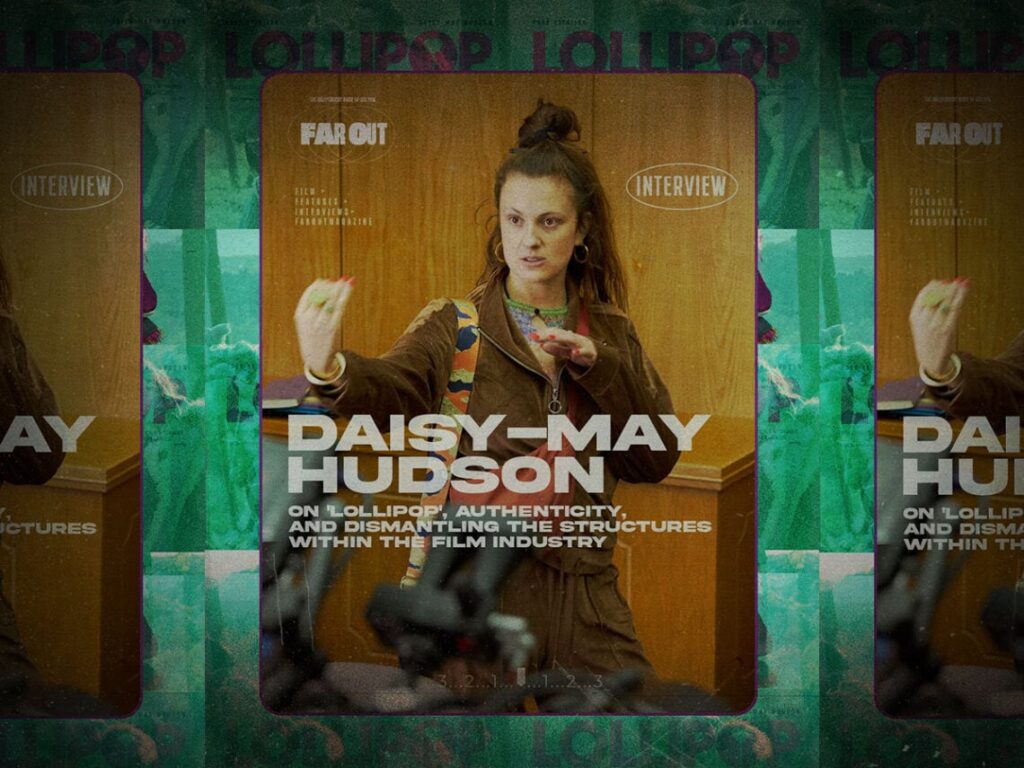
Daisy-May Hudson on ‘Lollipop’, authenticity, and dismantling the structures within the film industry
 Posted On
(Credits: Far Out / Metfilm)
The film industry has never been a carefree or fluid system – it’s a place of rigid rules and processes that gradually merge together to create films that, sometimes rather miraculously, don’t reflect the stiffness of the world that created them. But alas, every filmmaker with a vision must go through the same processes in order to bring their story to life, with many aspiring directors on the outskirts of the industry memorising the traditional routes to success in the hopes that one day, they will follow that same path.
But even within the most inflexible of industries, there is always room for change, with decades of creative anarchists who have blown apart the structures that define Hollywood and elbowed their way to a new equilibrium, something that first-time film director Daisy-May Hudson has achieved through the creation of her emotionally visceral and radically joyful debut feature, Lollipop.
Lollipop exists in a similar realm of cinema to the likes of Mike Leigh and Andrea Arnold, with the folds of social realism being the perfect way to convey one woman’s journey to be reunited with her kids after being released from prison, struggling against a catch-22 in the system that makes it borderline impossible for her to do so. But despite being failed by government policies and the social care system, Molly finds strength through community and the bonds of female friendship, putting on a brave face in the presence of enormous cruelty and taking matters into her own hands.
It’s an extremely grounded film, with the director immersing us in a story that feels alive with vulnerability and raw emotion, an ethos that lay at the heart of the production and influenced every aspect of the creative process. But due to her unconventional route into the industry, Daisy-May Hudson realised this story in a way that challenges all the norms in the industry, speaking to Far Out about creating a new way of working that reflected the heart of Lollipop, letting go of tradition and dismantling the filmmaking hierarchy.
Hudson began her foray into filmmaking as a means of necessity and survival, picking up a camera and deciding to document her family’s experiences of homelessness after being suddenly evicted, capturing their year-long wait to be rehoused and their lived experience of the housing crisis. As a result, there’s a documentary-esque feeling to Lollipop as it captures Molly’s experiences in a frank and frenetic way, highlighting the robotic and unfeeling bureaucratic processes that strip people of their humanity. After going through versions of this system herself, Hudson knew just how crucial it was for these people to be at the heart of the story, infusing the script with true testimonies from women who battled this beyond frustrating system themselves.

When sharing the beginnings of her creative process and incorporating truth into the story, Hudson said, “I love people. I love working with people. I know people. And I think maybe because I make documentaries, it’s all about creating space for people to be heard, and also that kind of heavily researched… you want everything to be factually accurate. So I borrowed from what I know. I spoke to incredible mothers protesting outside the houses of parliament, judges, social workers and family lawyers, and it was really important that even though there’s truth, there’s no blame. Because I think sometimes, when you get more issue-led films, you may experience blame or kind of an anger or an injustice, but for me, this is really about truth, and how do we feel about it”.
Despite the cold and unfeeling barriers of the system that Molly finds herself in, there’s a compassion and levity that no doubt stems from these real-life moments, with the story swinging between deep moments of grief and the highest pangs of joy. While there is anger and frustration, this anger is fuelled by a hope for something better, something that manifests in Molly’s character as she fights for something so fundamentally human while being treated in such a harsh and unfeeling way.
You can always feel the difference between stories that are informed by lived experiences and those that aren’t, with a grit and roughness that comes from being an unpolished version of the truth. Hudson expanded on this, saying, “I think the most powerful stories are stories told from your heart and from what you know. And you can tell when you feel it on a deeper level; when you watch something and you know someone’s lived it or knows it intimately, and that’s super powerful”.
While some filmmakers tend to exploit stories they have no lived experience of, the ones that remain most impactful are the ones that seep into your bones, touching on something that no one else could and articulating an experience through all senses. It merges with your own memories and almost becomes a part of you, with Hudson saying, “I think when you’re observing, there’s a difference between observing, and actually being in it. And I think you can tell when films are a reflection or an observation, because if I think about it, potentially this story or other British working-class stories, they’re often told through this feeling of like romantic nostalgia or sentimentality. And I think life’s a bit rougher and rawer than that. Like, that’s how I’ve experienced it anyway, and so I really wanted to convey that. It’s told through your body”.
This might not be the way that some people in the film industry operate, with many directors recently coming under fire for hinging their work around experiences they cannot understand (and making little effort to do so), Hudson is unconcerned by tradition and more by doing things the right way, something that was partially shaped by her unconventional journey into the journey and not being hindered by knowledge of how things are typically done. “I didn’t go to film school, I didn’t go up through the ranks, like, I don’t have the understanding of the normal structure of how things work as such. And I think that actually puts you in a really good position, because it means that you can imagine or create something new, and you don’t have to look what already is”.
In a business as rigid as the film industry, it’s hard to stay true to your vision and not bend to fit the status quo. But for a film like Lollipop, adhering to the system would contradict the very message of the film – it’s a story about rebellion, hope and finding your own way forward, something that Hudson brought with her into every aspect of the production. Care was the priority of each and every scene, adopting a trauma-informed approach that acknowledged the difficulty of the subject matter and the individual ways it might resonate with each person working on the film, with genuine safety always being the central concern of the shoot, which isn’t something the film industry always prioritises, despite desperately needing to.
But these barriers can be broken down, with Hudson paving the way for a kinder, less abrasive process of filmmaking that embodies the humanistic values of Lollipop, saying, “All of these systems can be reimagined. They can be reimagined to be caring and kind, and that doesn’t mean that you suddenly don’t get the job done, like the film was finished within budget, on time, and it still had care and safety at the foundation of it”. The film industry desperately needs more people like Hudson, and perhaps the triumph of Lollipop will prove how freeing it can be to stray from the crowd and that sometimes, destruction is the best form of creation.
[embedded content]
Related Topics