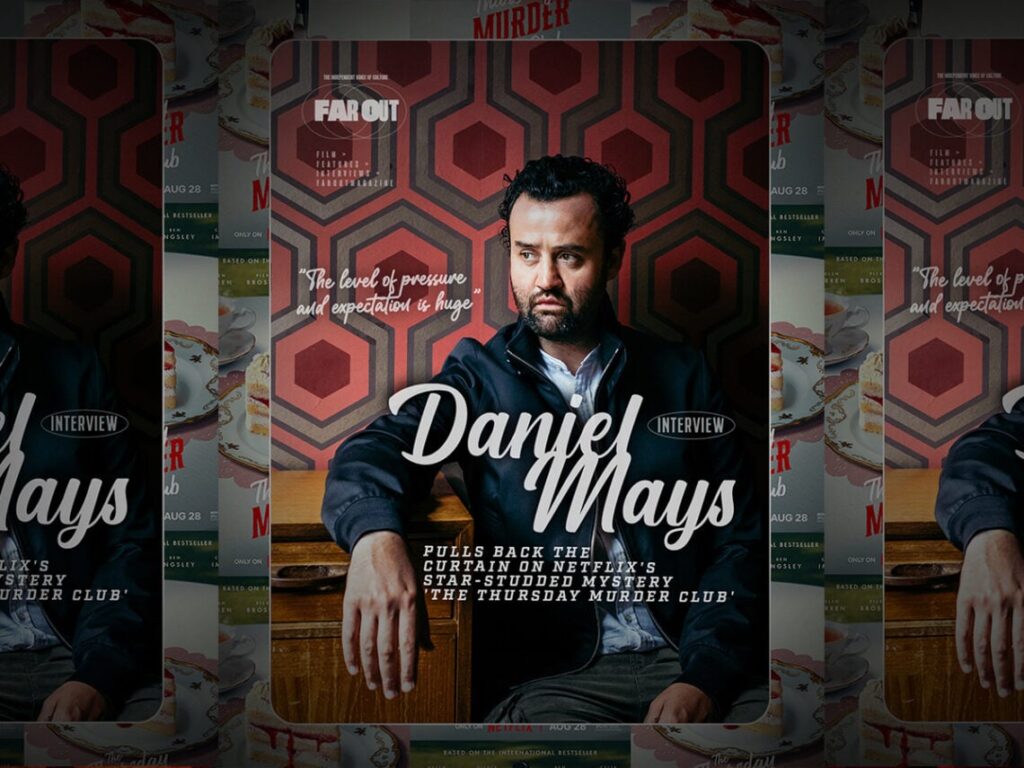
Daniel Mays pulls back the curtain on Netflix’s ‘The Thursday Murder Club’: “The level of pressure and expectation is huge”
 Posted On
(Credits: Far Out / Will Thompson)
As a quick glance at his extensive list of credits will tell any interested party, few British actors working today are as in-demand as Daniel Mays.
The Essex native has been a mainstay on film and television for the last two and a half decades, often shooting multiple projects all over the globe every single year, and that relentless pace has never really shown any signs of slowing down.
In the last two years alone, Mays has appeared in the opening two-part instalment of Mark Gatiss’ Bookish, the Disney+ docudrama Suspect: The Shooting of Jean Charles de Menezes, Steven Knight’s Victorian-era boxing drama A Thousand Blows, the AppleTV+ historical miniseries Franklin, and is slated to appear in an as-yet-untitled Jason Statham action flick. While shooting these projects, he has traversed more airports than he’d care to mention, and in each and every one, there was one constant that kept catching his eye.
“You’d walk through an airport, and you’d see The Thursday Murder Club at the top of the number one chart in all the bookshops,” the instantly likeable character actor recalled, “People were reading it on the plane, and I was like, ‘What’s that about?’”
To Mays’ surprise, he soon found himself in the frame to join Netflix’s movie version of Pointless, host to Richard Osman’s scandalously successful novel, which has since spawned three sequels, with a fourth to come later this year. “Here I am now in the actual screen adaptation of it,” Mays chuckled with a disbelieving shake of the head. “It’s been such a hit, that series of books, not just in the UK, but all around the world. I don’t think I’ve ever felt this level of expectation for a movie before. The level of pressure and expectation with it is huge.”

In the streaming giant’s adaptation, Mays plays DCI Chris Hudson, the latest in a long, long line of coppers he has inhabited onscreen. “I’ve played a lot of policemen,” he smiled, “Why not add another one to the roster?” It was his agent who put him forward for the role, having read the book and assured her client, “You are perfect for the policeman”.
Hilariously, Mays chose not to take offence when he realised Hudson is a “middle-aged, divorced, sad sack detective” who lives on Chinese takeaways and has chocolate wrappers in his coat pockets. With mock outrage, the 47-year-old Mays exclaimed, “You said I was perfect for this role? What are you talking about?!”
Any half-serious blow to Mays’ ego was instantly forgotten when he arrived at Surrey’s iconic Shepperton Studios for day one of The Thursday Murder Club‘s shoot. The project boasts a murderer’s row of talent both in front of and behind the camera, putting him in some genuinely legendary company. “When you have someone as incredible as Chris Columbus directing it, and you’ve got Steven Spielberg/Amblin producing it, and the calibre of cast they assembled,” he gushed, “for me, it ticks all the boxes. Honestly, I was pinching myself on day one to be in and amongst that group of actors.”
Indeed, “that” group of actors does include several true heavyweights. Helen Mirren and Pierce Brosnan (reuniting after the recent Paramount+ gangland thriller MobLand) play a retired spy and union leader, respectively, living out their twilight years in the plush Cooper’s Chase retirement village in sunny Kent. Along with Ben Kingsley’s psychiatrist and Celia Imrie’s nurse, this group of pensioners band together to roll back the years and solve the murder of the shady property developer who owns the village.
Alongside the core foursome, The Thursday Murder Club also features support from Richard E Grant, David Tennant, Jonathan Pryce, Naomi Ackie, Tom Ellis, and Sarah Niles, making it a who’s who of British acting from the past 50 years. With a cast list of that stature, it would have been easy for any member of the ensemble to feel some nerves on day one, and Mays was no different. However, the first scene Columbus chose to shoot was a group effort that gathered all the principal players together, and that neatly torpedoed any apprehension right at the beginning.
“It was a great way to start the process, because it just threw me into the deep end,” Mays admitted. “I’ve watched all of those actors all my life”. As Columbus had designed it, though, everyone felt like they were “launching off into the unknown” at the same time, and it wound up being Mays’ favourite sequence of the entire film. Still, he would be lying if he didn’t admit there was still “a little voice inside you going, ‘Don’t screw it up, Danny’”.
In the end, the excited star quickly got over any imposter syndrome that affected him at the start of The Thursday Murder Club. He is a hugely experienced performer in his own right, after all, and after poring over both the book and Katy Brand’s screenplay adaptation, he “fell in love” with DCI Hudson.
“I just latched onto the physicality of the character more than anything,” Mays explained, adding, “He comfort eats all the time, and that’s my way into it. I wanted to make myself look bigger than I am, so we went down the route of wearing a padded suit. I specifically wanted him to have that middle-aged spread, where men don’t necessarily change the size of their shirt, so when they sit down, their buttons just tighten!”
To his delight, Columbus was more than willing to allow the actor to improvise and was open to suggestion on other things, too. “Chris was amazing because he was so collaborative,” Mays revealed about the man who has two Home Alone films and two Harry Potter entries on his CV. “He was like, ‘Danny, look, if there’s a line in the book that you love, and you want to incorporate that into the scene, we could work it in’. He was very fluid like that.” Then, with a cheeky grin, Mays joked, “I was just coming in with monologues, you know!”
The more Mays put into playing Hudson, the more he realised how the character differed from all the other policemen he’s played. He drew particular comparison between the essentially good-natured Hudson and the corrupt, abused officer he played in the third season of Line of Duty, and admitted it was a nice change of pace to play a sweetly upstanding officer of the law.

“Danny Waldron was this troubled, dark, brutalised character,” Mays explained the contrast, “Chris Hudson is far from that. You know, he’s happy to drift along, but he’s a decent copper, and he wants to do the right thing. That, in turn, makes him very endearing to the audience. He’s certainly a hugely popular character in the book.” In fact, as a divorcee with low self-confidence, but a loveable nature, Mays confessed, “Your heart sort of breaks for him, because you want him to find love”.
Next up for Mays is another copper, DCI Brian Nies, in the BBC’s Lynley, a new version of the popular Inspector Lynley novels. After that, he will return as bartender William ‘Punch’ Lewis in the second season of A Thousand Blows opposite Stephen Graham, James Nelson-Joyce, and Erin Doherty. That season was shot back-to-back with the first one, which premiered to huge fanfare in February, and the performer would be surprised if the show didn’t rumble on for a few more years.
“I think it would be crazy if it didn’t go again,” he insisted, noting, “The first season went down so well, and the reviews were saying it was even better than Peaky Blinders and all this crazy stuff. I mean, the characters are so rich, and the world is so vividly created, but it’s all dependent on the green light from Disney.” For Mays, the sets built to evoke the grimy, dangerous, bare-knuckle boxing world of the East End in the 1880s were, “the most incredible” he’d ever performed on.
While he would love A Thousand Blows to continue, asking him about his time shooting the first season provokes a fascinating response. “It was just the most tiring thing I’ve ever done,” he claimed, before revealing that he was actually working two gigs at the time, and one of them involved eight stage performances per week. Even for a hard grafter like Mays, that was asking a lot.
“I had a sort of extended cameo as ‘Punch’ Lewis,” he revealed, adding, “I was doing a musical at the time, Guys and Dolls, at the Bridge Theatre in London”. Therefore, when creator Steven Knight called to offer him the role of Lewis, he said, “I just can’t do it. I’ve signed up for eight shows a week doing Nathan Detroit!” With a twinkle in his eye, he remembered Knight’s reaction like it was yesterday: “Oh, so that means you’re free in the daytime”.
Thus began a gruelling endurance test, in which he filmed A Thousand Blows from nine to five, before being bundled into a taxi and sprinting across London to tread the boards in one of the most popular musicals ever created, for weeks on end. “It was a hell of a feat to take on,” he said, shaking his head ruefully, “but I was pleased I did it in the end”.
While performing in Guys and Dolls, Mays admitted that the immediacy of the performance, in front of a crowd begging for more, was “like a drug”. He describes it as a “tidal wave of positivity and energy”, and is adamant that performing onstage is the closest feeling he’s had as an actor to the feeling of electricity sportsmen and women must get when they perform.
“The theatre is always the actor’s medium, for me, and you’re the one who has to take the audience on a journey every night,” he explained. “There’s a great responsibility and thrill that comes with that. But when you’re in a long run, it gets very tiring, and you have to have the discipline that every show is the first time you’ve told the story.”
Having said that, he’s not about to turn his back on film and TV, and he couldn’t honestly say he has a preference between live performing and working on sets/location. “I always just consider myself to be an actor for hire,” the humble star shrugged, “To me, it’s still the same process of creating a character, but there are pros and cons for both.”
This down-to-earth outlook also informs Mays’ opinion on the drive for improved working-class representation in British film and TV. He grew up in Buckhurst Hill with an electrician father, a bank cashier mother, and three brothers, and graduated from the prestigious Royal Academy of Dramatic Art in 2000. He recently returned to his alma mater to speak to the current crop of young acting hopefuls and was pleased to see “quite a few” kids like him among the student body.

“I know that RADA’s initiative is to try and hunt out kids from underprivileged backgrounds and working-class areas,” he revealed, “to give them a platform and allow them to audition and hopefully get into the college. There was a whole mix of different races and different social backgrounds.” These young actors breaking into the business can only improve the strive for “authenticity” at the heart of any class debate, and Mays does believe the industry has made great strides in recent years.
For instance, he recalled a viral article published around a decade ago that asked where the next Gary Oldman was going to come from if the industry and government didn’t support working-class voices, but now he points to the like of Daniel Kaluuya, Jack O’Connell, and his old mucker Nelson-Joyce, who Far Out also spoke to about this very issue, as examples of how the tide is turning.
“I just think it needs to be a positive melting pot for all, and as diverse as possible,” he concluded, musing, “That’s the way forward. I love it when I work with young actors, and you can see the potential, and you can see their careers take flight.”
The Thursday Murder Club is in select cinemas from August 22nd, before debuting worldwide on Netflix on August 28th.
[embedded content]
Related Topics