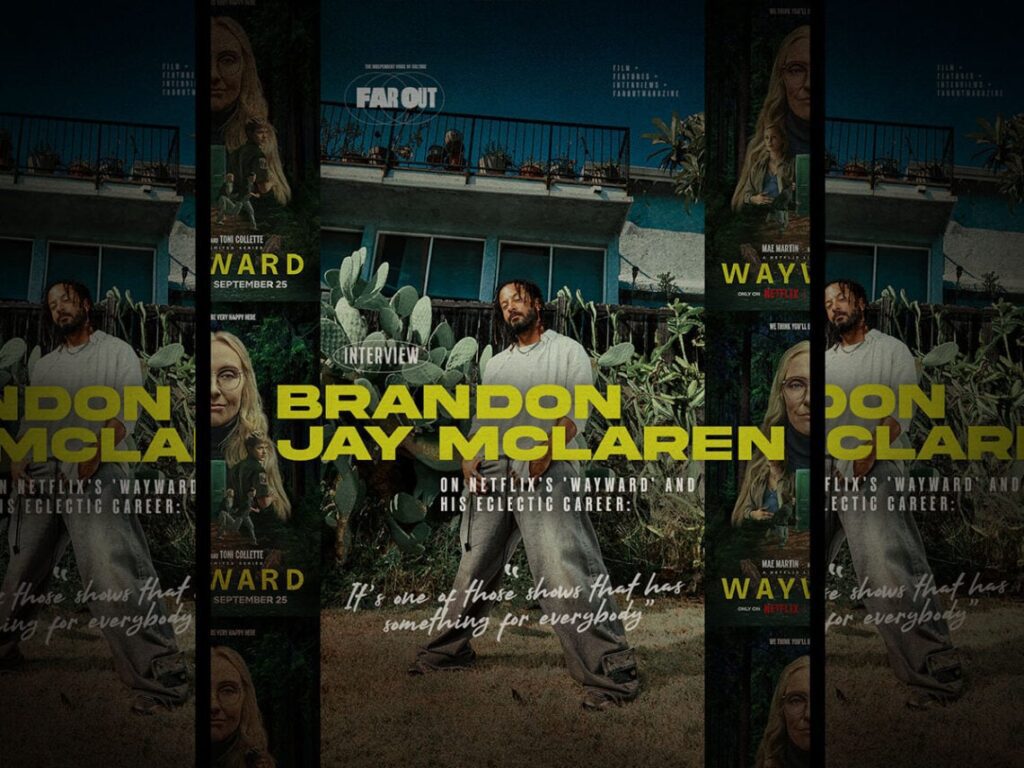
Brandon Jay McLaren on Netflix’s ‘Wayward’ and his eclectic career: “It’s one of those shows that has something for everybody”
 Posted On
(Credits: Far Out / Kegan Lamb)
Hailing from creator, co-showrunner, co-writer, executive producer, and star Mae Martin, the new Netflix series Wayward feels well-placed to become the streaming service’s next binge-watching obsession.
A combination of drama, mystery, and thriller, the eight-episode miniseries follows Martin’s Alex Dempsey, who moves into a new home in the town of Tall Pines, where his pregnant wife, Sarah Gadon’s Laura, grew up. Naturally, not everything is idyllic and picture-perfect as it appears at first glance.
The centrepiece of the isolated outpost is Tall Pines Academy, a school overseen by Toni Collette’s disarmingly charming and charismatic figurehead, Evelyn Wade. After encountering Sydney Topliffe’s Abbie and Alyvia Alyn Lynd’s Leila, two teenagers who become academy residents for very different reasons, Alex investigates a string of inexplicable and interconnected incidents that place Evelyn in the middle of everything wrong with a gleaming town that looks to be hiding a rotten core.
Martin’s fascination with America’s ‘troubled teen’ industry served as the impetus for Wayward, which explores themes of friendship, loyalty, generational trauma, and how the truth rarely stays buried forever, with Brandon Jay McLaren lending support as Dwyane Andrews, a member of Tall Pines law enforcement who seems to know more about the goings-on at the school than he’s willing to divulge to the newcomer.
It’s the actor’s second brush with Netflix after a six-episode stint on Firefly Lane, and even though he hadn’t seen Wayward when he spoke to Far Out, he’s confident that it’ll have people talking. “When they roll out the whole season at once, there’s this swell of energy that’s unmatched, you know what I mean?” he asked. “Because everybody’s talking about it at the same time. It’s really great, and it’s one of my most favourite things about working with Netflix.”

In terms of McLaren’s character, viewers might think they’ve seen someone like Dwyane a hundred times before, if not more, and to a certain extent, they’re right. He’s the veteran local cop who partners up with the out-of-towner who’s just arrived, and that familiarity is kind of the point, with Wayward hiding plenty of fresh tricks up a sleeve that’s archetypal from the outside looking in.
“That was always a balance that we tried to strike with myself and Mae, and the directors,” he acknowledged of intentionally underplaying his performative hand. “How much do we tease out in the things that Dwyane says, or in the looks that he gives? Every episode, we would play with the levels in terms of, like, ‘Let’s give a take where you give a little more away. Let’s do a take where you withhold a little more and then let them figure it out in the edit.’”
“Because then they can see how the rest of the show is playing out and where we’re at in the narrative, and they can cherry-pick what fits the best,” he continued. “So everybody was aware of that while we were shooting, we’re always like, ‘Let’s just make sure that we’re holding the bag tight so as not to let anything go too soon.”
Finding his way into a character like Dwyane, knowing there’s a certain number of cards he needed to hold close to his chest until Wayward’s later episodes, when everything starts falling into place, was a challenge acting-wise, but one that McLaren was eager to embrace.
“It is a little difficult because you’re almost playing two characters in one show,” he acknowledged. “So that can be a little bit difficult. At the same time, it can be advantageous because you always have this fire, the undercurrent that fuels you throughout the whole series. The hope is that you relay that in a way where when you look back, you’re like, ‘Oh, I thought it was that, but it was something else that’s like the golden ticket, if you can get it.’”
Obviously, McLaren can’t divulge specifics without giving away some massive spoilers, but Dwyane’s duality speaks to the show as a whole. It’s a subversively familiar series, with Wayward leaning into a number of tropes before pulling away at the last second and heading off in some unexpected directions, which was something he relished, especially in the final episodes.
“They kept sort of reworking the last four or five episodes as we were shooting, I think, based on seeing what they had already shot, and what was in the can already,” he revealed. “What I love about the show the most is that it’s very sort of Jordan Peele-esque in the way that it’s very genre-bending. There’s a lot of comedic moments, but there’s also a lot of moments that are very terrifying. It’s one of those shows that has something in it for everybody.”
There are genre elements at play, and Wayward definitely unfolds in a slightly heightened reality, but as mentioned previously, it deals with some serious, relevant, and timely themes as well. Performance-wise, how did McLaren find that balance between getting to grips with the material and then being on set, especially in a place like Tall Pines, where everyone is unsettlingly happy and smiley all the time, which obscures what’s really going on beneath the surface?
“I think, as an actor, the challenge is always not to judge your character,” he elaborated. “These people in Tall Pines all believe that they’re doing the right thing, and they believe it with their whole heart and their whole soul. They don’t think they’re doing anything nefarious. They think they solved an age-old answer.”
As for the question? “How do you solve generational trauma?” McLaren pondered. “And they believe that they have the answer. So if you come to the show, into the character with an earnestness and a real belief about what they think they’re doing is right, everything falls into place.”
Most of the star’s scenes are with Martin, which was a new experience for McLaren. After all, they aren’t just his co-star, but also Wayward‘s co-showrunner, executive producer, and co-writer. It was business as usual when the cameras were rolling, but it was nonetheless enlightening to be so close to the process.
“It’s great,” he remarked. “I don’t think I’ve ever been that close. You know, Mae would be rewriting scenes in the next episode and then rehearsing with me and then shooting it, and then going back and rewriting scenes. It was so cool to have that proximity to the process. Working with them was like being in the writers’ room, because they were right there the whole time.”
Not only did he find it “awesome,” McLaren also found it “aspirational” because he was up close and personal with “somebody who can work so hard and is so effective.” Martin and their fellow showrunner, Ryan Scott, have cited Girl, Interrupted, Get Out, Fargo, Booksmart, and One Flew Over the Cuckoo’s Nest among Wayward‘s myriad of influences, but he was nudged in a slightly different direction.
“I know, for me, when I talked to Ryan Scott about the show, he had pointed me to a documentary on Netflix called The Program,” he shared. Director Katherine Kubler’s doc, subtitled Cons, Cults, and Kidnapping, saw the filmmaker and her classmates reflect on their harrowing time at a behaviour modification facility sold as a boarding school, which drastically informed McLaren’s perspective.
“I watched that, and that expanded my whole world in terms of, ‘Oh, this was a real thing.’ And then I did a deeper dive, and you learn these schools were actual schools born out of, like, cults that had been broken up 20 years before. And really, what they did was they just rebranded them, but it was the same ideas. So, for me, that was the most valuable.”

Like many similar institutions, Tall Pines Academy also has an eerily entrancing figurehead at the forefront, with McLaren wishing he’d gotten more screentime opposite Collette. “She’s one of my favourite actors of all time, even before I got this show,” he confessed, before pinpointing his favourite moment from the Academy Award-nominated actor’s career.
“The Hours is one of my all-time favourite movies and books. And Toni has a scene in The Hours, which I think is one of the five best scenes in cinematic history. So I’ve always been a fan, and when I found out I was working with her, I mean, it was such an honour. And yeah, I wish I had a little more scenes with her, but just being able to be on set and watch her work, it’s the best learning curve ever.”
For all the reasons covered above, and more, Wayward is a hard show to talk about without wading into spoilers. However, without giving anything away, McLaren divulged his opinions on whether or not Dwyane deserved the ending he got, or whether he was simply doing the things he’d been conditioned to do.
“I think maybe Dwyane deserved a second chance, but I also understand why it came to that,” he teased. “That’s a great question that opens up a whole can of worms. You know, when people get indoctrinated or become part of a cult, how much of it is a result of them being brainwashed, and how much culpability do they have? That’s what’s interesting about shows like this, because you always have to talk about personal responsibility, and also the effects of brainwashing.”
After a tantalising answer that said plenty without giving anything away, it was time to head back to the start of McLaren’s career. Namely, his time as a Power Ranger. It’s been 20 years since he played the red-clad Jack Landors in Power Rangers SPD, and he continues to appreciate that people still want to talk to him about his time on the series that convinced multiple generations of schoolchildren to roundhouse kick their peers square in the face.
“You’re a part of television history,” he celebrated. “There’s only, I think, 20-something Red Rangers in the history of television, and I’m one of them. That’s pretty cool. It’s such a powerful brand that I don’t think it’s ever gonna die. 20 years later, I get six-foot-three 20-year-olds being like, ‘Yo, man, you were my hero when I was a kid. And that’s pretty dope.”
McLaren “had no idea it was gonna be this long-lasting and this far-reaching” when he signed on, but he doesn’t mind in the slightest: “I’m here for it.” Fast forward several years, and even though he’d been working solidly on television in things like The Best Years and Harper’s Island, the actor landed his breakthrough role when he was cast as Bennett Ahmed in the first season of The Killing.
“Immediately, when that show came out, everything changed, and it was fascinating,” he recalled. “While we were making it, I don’t think anybody knew that was gonna happen. Like, Joel Kinnaman became a huge star from that show. Patty Jenkins, who directed the pilot, is now one of the biggest directors in film. That show is really, really seminal for a lot of people’s careers, so I was grateful to be a part of it.”
“That show undoubtedly changed the trajectory of my career,” he agreed. The acclaimed crime drama saw McLaren appear in 12 of the 13 episodes as Ahmed, the teacher of murder victim Rosie Larsen. He was one of many placed under suspicion, and the series caused some unwanted adverse effects when he was out and about living his daily life during its run on screens between April and June of 2011.
“Oh, I have a story!” McLaren exclaimed. “While it was out, I was dating a girl at the time, she was living in New York City. We’d just come out of a Broadway show, and there’s a bunch of people around, and this older couple was like, ‘Hey, did you kill her?’ I was like, ‘Yo, you can’t say that in the streets!’ That was probably the funniest moment, because the show was so popular, and everybody was wondering if I killed Rosie!”
The Killing may have changed everything, but McLaren has amassed an eclectic body of work across film and television that dates back over two decades, and he feels like his career has reached something of a full-circle moment, with his small-screen work in particular continuing to pay it forward.
“It’s funny, I’ve gotten to this place now, and this has happened over the last year, where, 20/15 years ago, a lot of the writers who I was working with, they’re all showrunners now,” he ruminated. “To be able to be in it long enough where you’re starting to get a second round of working with people that you know and trust.”
Another thing McLaren finds “fascinating” is that “the material has changed a lot.” Specifically, he pointed to how “you’re getting more of these genre-bending shows like Wayward, where people want it all.” In the past, episodic storytelling was more fixated on occupying one box, whereas now, “you can put it all in a blender.” That said, “it’s also challenging for an actor because you always have to check in and see where you’re at, tonally,” but the versatile character actor has always remained in demand.
On the other hand, it’s not easy to navigate the constantly shifting landscape of TV, especially in the streaming era. In McLaren’s career, he’s been in shows like Graceland and Ransom, where he was in almost every episode for a number of years. Conversely, he joined the likes of The Rookie and Snowfall when they were years deep into their respective runs.
Then there are unfortunate casualties like the Disney+ reboot of Tom Hanks’ Turner & Hooch, which was canned after a single season, and that wasn’t even the worst of it. “I think they just removed it from the platform completely,” the actor seethed, with the show wrapping up in May 2021 before being taken off the streamer entirely in May 2023 as part of a cost-cutting drive and content purge.

“It’s almost like it never happened,” McLaren lamented. “You’ve just got to stay nimble, you know what I mean? I think that’s what everybody’s learning. You’ve just got to be proactive, you’ve got to keep making things.” Spotting the “silver lining,” he appreciates that “people always want to watch things and consume things,” it’s just dependent on “the vehicle by which they get it.”
As it applies to a working actor, McLaren embraces the industry’s ongoing evolution. “You know, what used to be those mid-level feature films are now Netflix series,” he suggested. “What used to be half-hour comedies are now little five-minute snippets. It’s the same thing, it’s just presented in a different way. So you’ve just gotta stay nimble and be ahead of it.”
Still, despite playing in almost every sandbox available, the actor isn’t sure he wants to dip his toes into what remains one of his career’s few uncharted waters: “I think the only thing I haven’t done, I’ve never done a multi-camera sitcom, and I’m not sure that I want to. I do like to follow up a drama with a comedy, or something with comedic elements, just to keep it fresh and keep all the tools sharp. That’s when I find I’m the most satisfied as an artist.”
In honour of McLaren’s wide-ranging list of credits that covers virtually every genre under the sun, apart from a multi-camera sitcom, Far Out decided to play a little game by naming several of them at random and pressing the actor for his thoughts and recollections. To kick things off, what better than his pivotal role as Skater Dude #2 in the James Gunn-scripted Scooby-Doo 2: Monsters Unleashed?
“I learned a very valuable lesson, because I think I’d only been on set maybe once or twice before, and I thought it’d be really cool as a stoner to have the munchies and have a pepperoni stick. Little did I know that I’d be doing this for 29 takes, and so I had to keep eating pepperoni sticks for continuity, and it was disgusting! Lesson learned.”
There is somewhat of a method to this role recall madness. The Scooby-Doo movies were written by Gunn, who helmed 2025’s Superman reboot, while McLaren was in a couple of episodes of Smallville: “Yeah, I was in two different episodes, playing two different people, which is bizarre. I did a scene with Bow Wow, who was very big at the time. And Bow Wow kills me. So that’s what I remember about Smallville.”
Next up, and included for its title alone, was the 2008 made-for-TV horror movie Yeti: Curse of the Snow Demon, the 14th instalment in the Maneater film series broadcast on the Sci-Fi Channel. “Yeti was interesting,” McLaren reflected. “I met one of my good friends on that movie, so that was good. Yeti was very cold. We were stuck up on a mountain with not much warmth for ten hours a day.”
Was it an experience he wants to replicate? Not really. “Don’t know if I’d do something like that again. Think I’m good on that.” Sticking with sci-fi, McLaren’s six-episode arc as Jamil Dexter on Falling Skies ended when he was killed by aliens in a TV show executive-produced by Steven Spielberg.
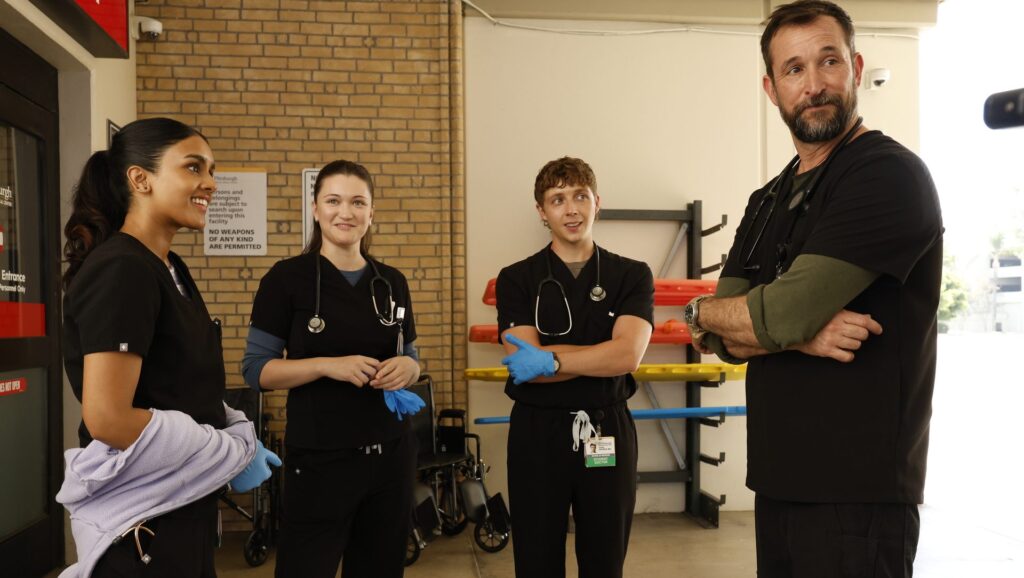
“And Noah Wyle, who has The Pitt out now, which is all the rage,” he added. “Falling Skies was a great experience. I think the person who cast me in that, or one of the writers, actually cast me in an episode of CSI that I did years before, and that was my very, very, very first job I booked in Los Angeles. And then when I was doing Falling Skies, I booked the Graceland pilot, and then they killed me.”
McLaren mentioned CSI before Far Out had a chance, since every up-and-coming actor is seemingly obligated to appear in at least one episode of the long-running crime show or one of its many spinoffs. “Yeah, it’s a rite of passage,” he concurred. “When you move to LA, you gotta do one CSI.”
He also landed a role in the Jordan Peele-fronted Twilight Zone reboot in the second season episode ‘8’, which was directed by Justin Benson and Aaron Moorhead and carried shades of John Carpenter’s The Thing, tracking a team of scientists in the Antarctic who start getting picked off by mysterious creatures.

“That was incredible,” McLaren declared. “I was such a fan of the show when I was growing up, and so we did a little promo thing. I mean, it’s Jordan Peele, so, you know, that’s royalty. But I got to say, ‘You’ve now entered the Twilight Zone in the promo,’ and for me, I was like, ‘I can’t believe I’m saying that,’ because I was such a fan of it as a kid, so that was really cool.”
Shifting focus to a certified cult classic, horror comedy Tucker & Dale vs. Evil: “I’ll tell you a story about that,” McLaren began. “Jesse Moss and I were roommates at the time in LA when we both auditioned for the part. So we were living together, and we put each other on tape. I can’t remember his character in the movie [Chad], but he played like the lead college kid. We both got the movie together, so it was really, really cool. It was the only time I had done a movie with my roommate.”
Last, but by no means least, McLaren’s leading role as Dale ‘Jakes’ Jenkins in Graceland, which won him a Golden Maple Award in 2015 for ‘Best Actor in a TV Series Broadcast in the US.’ To be more specific, do people on the street still call him ‘Chocolate Jesus’ as he was dubbed in one episode?
“My favourite project that I’ve done,” he announced. “I think it was cancelled too soon. I remember when the writer came up to me, he’s like, ‘Brandon, I put something in the next episode for you. I want to know when you read it. I want to know if you can find it.’ And that was the ‘Chocolate Jesus,’ and that’s a forever line. I love that show. I wish we could do more.”
Doubling down on his admiration for the three-season procedural, the actor declared it his definitive performance. So far, at least: “I think it was the most rounded performance. I think it was the most I got to play, you know, the most full character. Conflicted. Wins, losses. I would say that shows the broadest parts of who I am as an actor.”
If there were one part McLaren would love to play from the past, present, or future of film and television, though, he set his sights high. “Any role ever in the history of history? I mean, this is the thing. I probably couldn’t pull it off, but maybe Malcolm X, I would say, but Denzel already did it, and he did it so good.”
Regardless of whether the opportunity ever comes around, one thing’s for sure: after more than 20 years as a fixture of screens big and small, McLaren won’t be going anywhere anytime soon.
[embedded content]
Related Topics