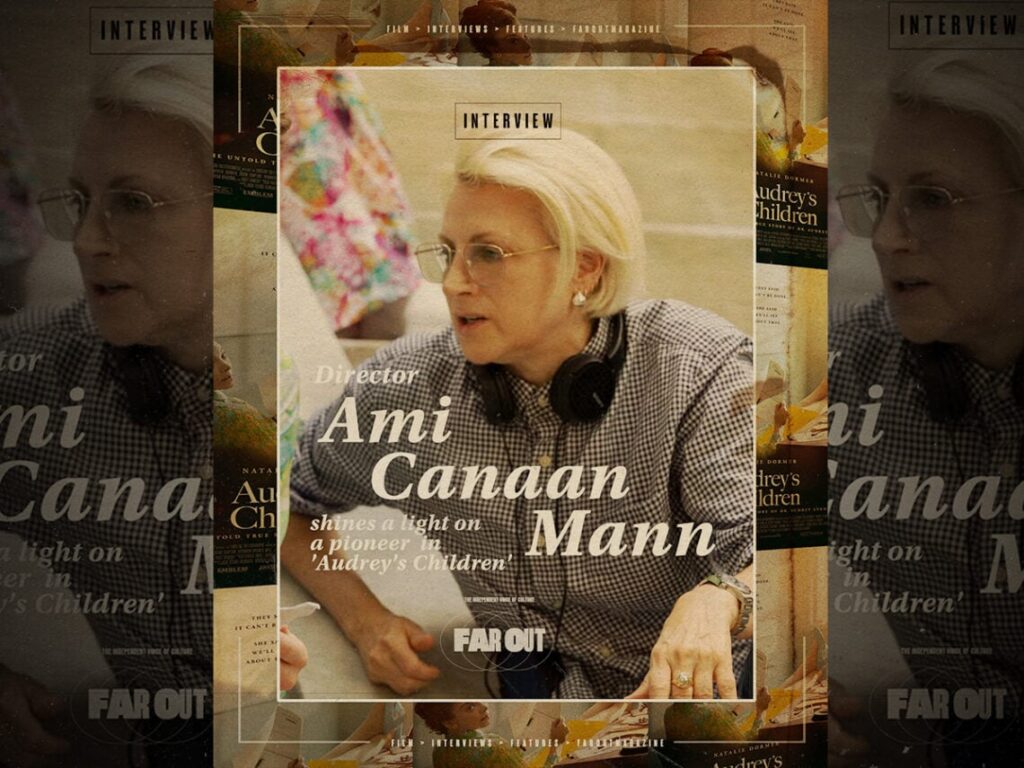
“If she had an issue with anything, she absolutely would have told us”: director Ami Canaan Mann shines a light on a pioneer in ‘Audrey’s Children’
 Posted On
(Credits: Far Out / Blue Harbor Entertainment)
Audrey Evans’ life story may not be as well-known as it should be, with the British-born American spending most of her career working at the Children’s Hospital of Philadelphia, where she became established as one of the leading pediatric oncologists in the field.
In the 1970s, she revolutionised the treatment of cancer in children, earning her the ‘Mother of Neuroblastoma’ moniker. Director Ami Canaan Mann’s biographical drama Audrey’s Children zeroes in on this transformative period in Evans’ life and career, with Natalie Dormer in the lead role.
Chronicling Evans’ fight against sexism, medical conventions, and the subterfuge of those in her profession while developing those pioneering treatments, which became known as the ‘Evans Staging System’ and reduced fatality rates by over 50%, the story also showcases how she co-founded the Ronald McDonald House Charities, a nonprofit organisation that’s expanded into over 60 countries with the aim to directly improve the health and well-being of children and their families.
Evans, who passed away in September 2022 at the age of 97, just two weeks after principal photography on Audrey’s Children started, lived a remarkable life. However, it’s taken a while for the film to reach screens. Mann was first announced as the director in May 2022, with shooting beginning later that year.
Audrey’s Children premiered at the Tribeca Film Festival in June 2024 and was released in March 2025, so it’s been a long road. That said, some of the circumstances were out of Mann’s control, and she thinks it may have been a blessing in disguise that her latest feature wasn’t rolled out last year.

“If you’d asked me in 2024, I would have said, ‘It’s really time for this movie to come out,’” she said. “But weirdly, I feel like this moment is the best moment for this movie to be released. I think it actually ends up being perfect timing, just in terms of the subject matter about science and research and the pursuit of medical advances and how that can exponentially help people, particularly children. I don’t think there’s a more timely issue, in a way, so I think it’s found its perfect moment.”
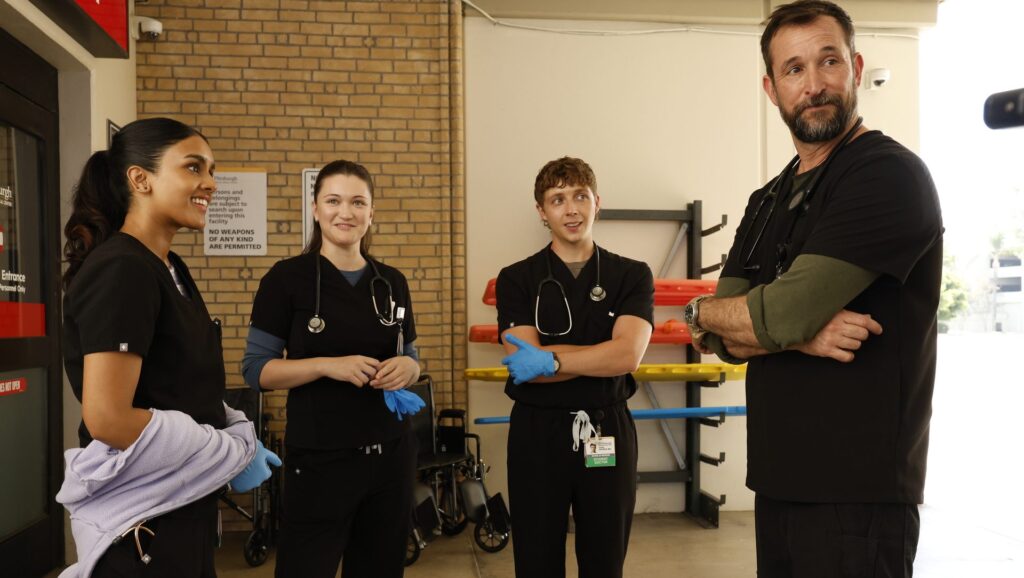
It’s been a while since Mann’s last movie, 2014’s romantic drama Jackie & Ryan, but she’s remained busy behind the camera by helming episodes of a number of eclectic TV shows, including The Blacklist, Chicago Med, Marvel Comics adaptations Cloak & Dagger and Runaways, and Netflix originals House of Cards and In from the Cold, and that sabbatical from cinema was intentional.
“I did TV for a stretch by design,” she explained. “I was at the Venice Film Festival with my film Jackie & Ryan, and for some reason, I saw a poster of John Ford’s credits and realised that I didn’t recognise any of them for a minute until it got halfway through the list. And it occurred to me in that moment. It was a studio system, and the stakes were a lot lower, and you could sort of have boots on the ground and fall on your face and make mistakes and learn, and, you know, all the things. And so I thought to myself, ‘I need to go do TV.’”
Mann saw the small screen, whether it was network or streaming, as a place where her skills would be challenged. “I don’t necessarily have all the tools in my toolbox,” she offered. “I’m sort of limited by the visual lexicon of each project, and that sort of restriction would expand my capacity as a director. And then I was really lucky; I got to do some really fantastic, visually disparate shows.”
Directing the first two episodes of the espionage thriller In From the Cold sent Mann “back to my roots of creating an entire visual world,” and when she read Julia Fisher Farbman’s script for Audrey’s Children: “I thought, well, this is a really terrific directorial challenge. I mean, not only visually, in terms of creating a super thorough world that is 1969 Philadelphia, but also just her story.”
“It was the scene on the roof with the little girl that really was the moment where I thought, ‘Yeah, this is definitely a movie I want to help tell’ because I found her character in that scene to be so incredibly selfless and egoless. You know, nobody wants to have a conversation. She’s having a conversation with her patient, who will likely die, about how that patient conceives of her own mortality in a really gentle, beautiful way.”
Mann acknowledged that “no adult wants to have that conversation with a child, let alone a child you’re meant to save and likely, statistically, won’t be able to.” That scene was enough to convince her Audrey’s Child was something she needed to make: “I thought, ‘This is a woman who really if I can do anything to try to help tell her story, I’d like to.’”
There was an air of serendipity to Dormer landing the lead role. Mann had been influenced by hearing legendary director Peter Weir talk about his approach to casting, and it was while watching the 2018 miniseries Picnic at Hanging Rock – an episodic remake of Weir’s 1975 literary adaptation with the former Game of Thrones star in the lead – the filmmaker realised she was perfect for the part.
“Yeah, I know, it’s crazy, right?” Mann agreed. “It definitely was serendipitous. I mean, I’ve been a long-time fan of Peter Weir, so yes, that interview that I heard with him, where he talked about casting, really stuck with me. I was in my car, and the interview came on. I just stayed in my car to listen to the entire interview and then have it be the remake of Picnic at Hanging Rock? Yes, definitely. It all kind of came together in a really beautiful way.”
Evans’ story may not be familiar to everyone who watched the movie, but it might encourage them to head down the rabbit hole and find out more about her achievements. Her career spanned well over half a century, and Mann hopes that her film about a small period in the subject’s life will lead to an uptick in interest in her accomplishments from viewers desperate to know more.

“I hope we captured the essence of her, and she did decades’ worth of really incredible work. It’s really easy to go down various rabbit holes. Dr Dan D’Angio as well. I mean, he was a premier radiologist, and as it’s shown in the film, the technique at the time was to radiate the entire body, and he was busy custom-making iron plates that could be placed over the children’s parts of their body that didn’t need radiation, and to try to protect those organs from the radiation. The entire community, and then the two of them, and then, of course, her, it’s kind of astonishing what they did.”
Screenwriter and producer Farbman penned the script and knew Evans personally for a long time, and there was a close collaboration with Mann to ensure that their individual and shared creative aspirations were realised, but did so in a story that focused on a specific period while still relaying to the audience the impact of her entire life and career.
“My approach to it directorially was to think of it as a character study. That this is the study of a woman who was extraordinary and was also incredibly human,” the director elaborated. “She’s flawed, and you know, in the story that comes out, she goes a little too far. She should maybe go this way, and she goes that way instead. Sometimes, she’s her own worst enemy.”
“Directorially, my bet was that if we could render her a completely multi-faceted person/woman, then she would be relatable. If she was relatable, then you could feel like you were walking shoulder to shoulder with her, and if you could feel like you were walking shoulder to shoulder with her through her journey, you would be as devoted to her achieving her objectives as she was, and that objective just happened to be doing what she could for kids with cancer.”
Audrey’s Children might be set in the past, but Mann’s hope was that modern audiences wouldn’t only identify with Evans as a character but relate to some of the themes that remain relevant today: “If you could create this relatable character you’ve been on this journey with, at the end of it, perhaps we would come out the other side of the story thinking of her as a sort of an exemplar of a way to walk through the world.”
Mann knows it’s “a world that can be, at times, and certainly right now, feel overwhelmingly disassembled and chaotic, and it’s easy to feel disparaged and disheartened and think, ‘We can’t. What can I fix? It all feels so big.’” And yet, she saw Evans as an example of “looking at what you can do, what is your skill, and directing that towards the most vulnerable people in your care and maybe making that kind of a difference.”
Audrey’s Children is a period piece, a medical drama, and a biopic, three genres that all have their own unique set of tropes and trappings. It was important for Mann to embrace the film for what it was while still imprinting it with a distinct visual aesthetic, something that was a key part of her approach from the start.
“The style, the look, and having that visual consistency was very critical to me, and I got to give my hats off to my production crew, who were able to pull off that visual lexicon mandate with very little money and very little time. You know, hats off to all independent filmmakers here. We did it in 23 days with a six-week prep.” Mann was aware of the pitfalls, and she made a point of avoiding them at all costs.
“It’s the kind of movie that could easily tip into some other genre of movie that I’m not interested in making. And I didn’t think would be compelling, in my opinion, and I didn’t feel like it would platform the story as effectively. I felt like if the movie could have a very specific visual language, which was Ektachrome, that was, again, the visual mandate there.”
Mann’s visual mandate was “no primary colour, very saturated colours, no blacks, whites, greys.” In addition, there had to be “very judicious use of red” because “it had a feeling of texture,” and “if it had a feeling of patterning, it could be a place you feel you could get lost in.” That was key, especially as it related to her intentions for the viewer.

“If you, as an audience, could feel like you were lost in it again, you’d be more inclined to follow her journey and follow her narrative. And that meant from top to bottom, from the wallpaper to every chair to every car to every dress to every pair of shoes, needed to be thought about and carefully curated to match that idea.” Another non-negotiable was to shoot on location as much as possible, which included some of the backdrops where the events depicted in Audrey’s Children unfolded.
“Personally, just as a director, I don’t love shooting on a soundstage,” Mann said. “I like shooting in real locations. I think there’s an X factor that you get with real locations, which is kind of great. And sometimes, the challenges in a real location become an asset. The hospital was an abandoned hospital. The current Children’s Hospital of Philadelphia is super modern and very tricked out, and so we had an abandoned hospital that we dressed to feel period.”
A self-proclaimed “detail-orientated person” and fan of location scouting, Mann wanted to utilise Philadelphia’s “incredible architecture” as much as possible. “It was important that everything felt authentic and period. I looked at a lot of Philadelphia street photography from the ’50s, ’60s, and ’70s, just to make sure that we had the right vibe and content.”
One prominent scene in the trailer, in which Dormer’s Evans jumps into a swimming pool fully clothed to capture the attention of Clancy Brown’s surgeon-in-chief, Dr Everett Coop, didn’t actually happen. Still, it was in character for Evans, and she signed off on the script and the cast before Audrey’s Children started production.
“I had the good fortune of being able to meet her twice, which was terrific, and then she passed two weeks into principal photography, and she met the cast,” Mann shared. “And, of course, she’s very close to Julia. Julia had read the script to her, and she approved of the script, and she sort of gave her a sign-off on everything. So, I felt like we had her blessing.”
“As she is portrayed in the movie, it was true in life,” the director expounded. “Even at 97 when I met her, she was as sharp as a tack. And if she had had an issue with anything, she absolutely would have told us. So I feel like the moment in the pool was definitely creative license, but she felt like it captured her spirits, and that’s good enough for me.”
Evans and D’Angio, played by Jimmi Simpson, got married when they were in their 80s and made a point of doing it at 7 o’clock in the morning so they weren’t late for work. It’s one of those stories that sounds too far-fetched for a writer to come up with, and Mann was always keen to end Audrey’s Children on a note that adds additional details the narrative didn’t have room to explore.
“When my editor and I built that end sequence with the images of the children and put those cards up, just when I first saw it, I got a little welled up,” she revealed. “I mean, it’s such a beautiful testament to their love story, which was one of the things that really attracted me to directing this project. I really loved the idea of telling a love story between a man and a woman, or between two people, where what they fall in love with first and foremost is the way each other thinks, and there’s an equanimity there. There’s a mutual respect there. And so the coda of them getting married so late in life and then going to work just felt like a perfect full circle testament to that type of love and that love story.”
Mann’s work in film and television, from her 2001 debut, Morning, to Audrey’s Children, has covered biopics, drama, romance, action, espionage, procedurals, politics, thrillers, and superheroes, and she’s not done yet. “I like to go into a genre and just see what I can do with it and what my take is going to be on it,” she said. “I would very much like to do a gothic horror period piece, and I also would like to do a sci-fi. We’ll see what happens.”
Speaking of gothic horror, if Mann has such a thing as a dream project, she knows exactly what it would be. “There’s a project that I have that I would very much like to do, which is a gothic horror piece,” she confirmed. “I’m a little I’m a bit of a book nerd, and I’m a little bit of a Henry James nerd, and it’s an adaptation of The Turn of the Screw by Henry James.”
Adding, “I feel like it could potentially be an incredible allegory for the times that we’re living in right now, in terms of a very subtle commentary on authoritarianism and power dynamics. But couched in a gothic horror that would also be scary and terrifying. And I think if there was just the one that I could wake up tomorrow morning and walk on set and go do, it would probably be that.”
Based entirely on her willingness to dive into as many disparate genres as possible, if anything, a gothic horror with a contemporary edge sounds like a logical next step.
[embedded content]
Related Topics