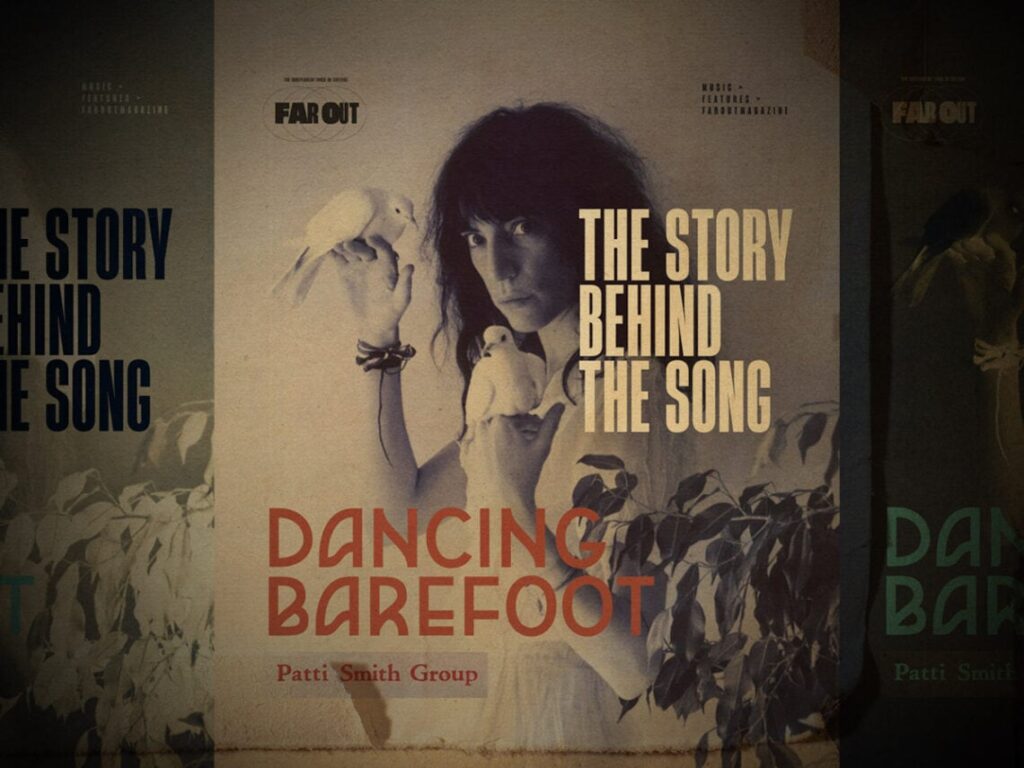
The Story Behind the Song: ‘Dancing Barefoot’ by Patti Smith
 Posted On
(Credits: Far Out / Arista)
One of Patti Smith’s most captivating attributes is her unashamed worship of her heroes.
She creates art not because she has to, but because she feels compelled to do so. It is as though the ghosts of her literary, artistic and musical heroes call to her like sirens, leaving her no choice but to create in their honour. This dedication is heard best in her song ‘Dancing Barefoot’, not just an ode to a fallen muse, but a tale of resilience.
50 years ago, Smith sent a lightning shock through rock ‘n’ roll with her debut album, Horses, a radical blending of poetry and song. She brazenly set her poetry to the discordant guitar stylings of Lenny Kaye, elevating the act of writing poetry from a solitary one to a communal experience – and indeed, an art form in itself. Emerging in the midst of punk’s slow but certain rumbling across New York City, Smith immediately set herself apart from her contemporaries, consciously or not. She appeared as neither woman nor man, singer nor musician. She was a secret third entity, creating art for art’s sake and operating beyond the confines of gender or genre.
Four years and three albums later, Smith entered the studio with her band, the Patti Smith Group, to record her fourth album, Wave. Produced by Todd Rundgren, the album remains something of a hidden treasure, hearing a whimsical side to Smith that diverged from the punk mould people often attempted (and largely failed) to place her in. The second song on the album is ‘Dancing Barefoot’, a stunning story of devotion.
In the album’s liner notes, Smith wrote, “Dedicated to the rites of the heroine,” before attributing ‘Dancing Barefoot’ to Jeanne Hébuterne, the mistress and muse of Italian artist Amedeo Modigliani, who followed her lover to his deathbed by taking her own life. This forms the crux of the song: it echoes a morbid romanticism that lures the listener. Through Smith’s pen, however, the woman is heralded as a blessing, rather than a curse. “She is benediction / She is addicted to thee,” Smith muses, “She is the root connection / She is connecting with he.” As the backing guitars strum similarly to a harp, Smith’s voice is enchanting as she casts her devout spell.
Smith wrote on her website that ‘Dancing Barefoot’ signifies “the love of one human being for another and the love of one’s creator”. Knowing Smith’s intensity, the notion of “love” is no simple feat; like all facets of her life, it is all-consuming and requires an unwavering resilience. Still, in all of her brilliance, Smith finds herself bewildered by the strength of her emotions. She cries out: “Here I go and I don’t know why / I fell so ceaselessly / Could it be he’s taking over me?” Smith reaches a semblance of holiness, found in religion, art, music, all of the life forces that drew her to write in the first place, but she doesn’t feel fear; rather, she succumbs to being overtaken, joyous to be seen through the eyes of another.
The chorus hears Smith cry, “Some strange music draws me in / Makes me come on like some heroine”. Smith once stated that she was told to replace “heroine” with a synonym because of its similarity to the drug, but she refused, choosing to sacrifice potential criticism over her art. As ‘Dancing Barefoot’ oscillates from dizzying sonic heights to moments of calm, Smith wraps herself tighter and tighter to her object of fascination. “She is re-creation / She, intoxicated by thee / She has the slow sensation that he / Is levitating with she,” Smith reveals, as her heroine reaches beyond the barriers of her devotion.
Smith captures the feeling of being engulfed in the love of another, and whether it be romantic, platonic, or something inexplicable, she communicates the sense of loyalty that has captured her. The ending of ‘Dancing Barefoot’ hears Smith recite her poetry, a meditation on life and death, with each line echoed by her muffled cry of, “Oh god, I fell for you”. Her questions of, “Why must we pray screaming? / Why must not death be redefined?” can be read as a plea to her heroes, a prayer that asks that even in death, they guide her towards salvation. She loses herself in prayer, and the song takes a visceral turn; you can hear the tremble in her voice that inevitably produces a similar reaction in you.
Written just before Smith would decide to leave behind her life of rock ‘n’ roll to devote herself to her family, ‘Dancing Barefoot’ alluded to the softer, more romantic side of her that was destined to emerge. She infuses the track with the esoteric, which weaves its way into all of her work, but holds a stronger power in the lines penned for this particular poem. It transcends conventions of song, becoming a prayer in itself. Most of all, the song proves Smith to be no ordinary artist, but a true spiritual communicator.
[embedded content]
Related Topics