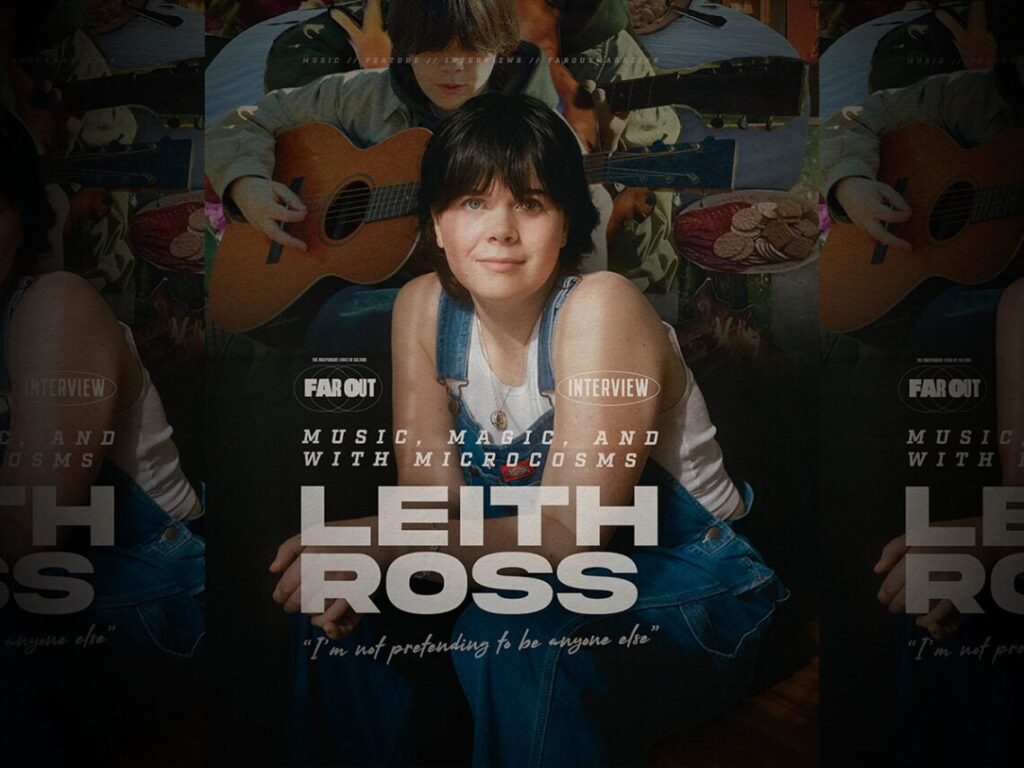
Music, magic, and microcosms with Leith Ross: “I’m not pretending to be anyone else”
 Posted On
(Credits: Far Out / Adam Kelly)
I hate coming across like the Gen Z version of William Wallace to the people that I interview, but I also can’t help myself from asking whoever I speak to if they have any connections to my home country of Scotland. With Leith Ross, however, that link is much more on the nose.
Regardless of where you may come from, it’s been hard to miss the Canadian singer over the past few years, so long as you have a TikTok account. Their breakout song, ‘We’ll Never Have Sex’, went massively viral on the platform four years ago, and ever since, they have been on a process of working out what being an indie folk star in the juggernaut social media age really means.
Despite all the virality and chaos that has inevitably been thrown at them, when I speak to Ross over Zoom, they seem viscerally present and calm. Of course, with a distinctive name like Leith and their 2020 debut EP being called Motherwell, there was one burning thing I had to get off my chest first: “What exactly is your connection to Scotland?”
Ross smiles warmly. Time, space, and generations have clearly never worn away at that aspect of their identity. “My mum was born and raised in Motherwell; well, she immigrated when she was a teenager, but most of my family’s still there. Both my grandparents were from Glasgow.” I laugh at the stereotypical trope we’re managing to brew, as I admit that my own mum also grew up near Motherwell.
“Oh, my god, wow!” Ross exclaims, “A small world. I suppose Scotland kind of is a small world.”
They’re certainly not wrong, and it seems an apt place to begin as we open up into the microcosmic universe and influence of their latest album, I Can See The Future. Spanning from traditional folk to jazz, the record is simultaneously Ross leaning into all areas of their life: their heritage, their foundations, but also their experimentalism. This manifests itself in areas like the “Celtic influence in the fiddle lines and stuff, and there’s as much of that as I could fit in every time I wanted something to have an air of nostalgia,” they explained, before adding that incorporating a twist on the pop realm was “really fun” to “put my songs into those settings and see how they married a little bit”.
“I like that the music industry has become more democratic”.
Leith Ross
The sonics only tell part of the story of where I Can See The Future has branched to. Opening and returning to the song ‘Grieving’ as the penultimate track, it’s clear Ross’s thought process behind this is concentrated on the listener’s experience as much as their own. “My idea was that if someone was listening to the record, like front to back in order, that it would inspire them to be present, to think about themselves in their life through the lens of the songs, but in a way that makes them really able to appreciate the revelations that they’re coming to or the ways that they feel about people.”
As they speak, it’s more than evident that this is a process Ross has had to reckon with themself before they could package it out to the world. How does that feel then, putting your neck out on the line in the name of art? “It’s an exercise of figuring out how to be OK with insane amounts of vulnerability, I suppose,” they admit, adding, “It’s mostly the emotional thing that I struggle with, the revealing of all my thoughts and feelings to the public. Yeah, sometimes I just have a little bit of a hard time with that.”
Vulnerability and visibility on a mass scale is certainly something that the singer is more than familiar with now, four years on from their song ‘We’ll Never Have Sex’ creating a tsunami on TikTok. But the rose-tinted naivety has worn off in large parts of the industry for all the relatively short time that social media success has dictated current music trends. The feelings everyone has are complicated, not least for Ross, who entered the storm and came out the other side.
They evidently don’t have a concrete answer when it comes to their true perception of virality. “One thing that I’m passionate about making clear, though, is that I like that the music industry has become more democratic in some senses,” they muse. “Any person can get online, post a song, and try to have a music career. That’s pretty incredible, because the industry was pretty monopolised by labels not so long ago, but obviously it comes with the addition of every single streaming service being evil. I was so lucky, but there’s still general social bias that makes it harder for some people than others. But I like that it happened.”
Naturally, in a journey of bringing their music to the masses and all that comes with it, bigger production ventures were also at hand within I Can See The Future. Working with prolific pop producer Rostam was one thing. “I’ve been a fan of his for such a long time,” Ross confesses, but it also meant taking leaps into new ventures within the sonic spectrum. The song ‘What Are You Thinking?’, a treasure trove of jazzy indulgence, is certainly nowhere near as reliant on the folk and pop realms that they have cited so far.

“Honestly, I especially listened to Nora Jones and Diana Krall when I was young, those slow, jazzy, beautiful ballads that had so much space in them. I’ve just always had such a positive association with that feeling and with that music, and I really wanted to mimic that romantic drinking of red wine and making pasta in your cosy, orange-lit kitchen, kind of vibe,” they say. To all intents and purposes, that sounds like a night sent from heaven, but don’t be fooled. Despite the moments of warmth on the album, the darkness also most definitely still creeps, which is something that Ross has often gone to pains to express.
Returning to the narrative of the two ‘Grieving’ tracks, the singer said the double inclusion was purposeful to “represent the two different extremes of that emotion”. You just have to overcome the challenge of traversing the complex palette of feelings that throws itself up in between. “There’s a lot of joy and stuff, but there’s also a lot of misery and sadness and grief,” they point out, which may be an obvious statement, but it equally evokes the notion of precisely how personal I Can See The Future really is.
“Everything in between is all written from my perspective. I’m not pretending to be anyone else, and they’re written as Leith about Leith,” they note, creating a parallel between themselves and the experience they want to grant the listener. That’s the most striking thing that emerges throughout my time chatting to Ross: they’re not just viscerally present but also seem to fundamentally understand the increasingly lost art of human connection.
Zooming out on the bigger picture of the album—bursting the bubble of the microcosm, if you will—Ross sees what truly matters. “I feel like people are often attached to this idea that musicians make magic, and that music comes from this kind of ether that isn’t really sensical. I think that’s what leads to us idolising musicians, [because] we feel like they’ve just created something out of nothing, that it’s kind of superhuman. But the thing that’s most inspiring to me about music is that actually it is incredibly human; it’s like one of the most human things you can do.”
Of course, albums and musical explorations of fantasy and filmic worlds all have their place. But for Ross, the process is always going to be rooted in reality, even if that means exposing some of their most private and vulnerable truths in order to share it with the world. They seem more contented with this idea by the end of our conversation.
“The best part is not the mysterious magic. The best part is that it’s such a human endeavour that we all share.” Baring your soul is never easy, but if Ross really can see into the future, it may well take them on a journey beyond their dreams.
[embedded content]
Related Topics