Why was Egon Schiele sent to prison for his art?
 Posted On
(Credits: Far Out / Josef Anton Trčka / The Yorck Project / Leopold Museum)
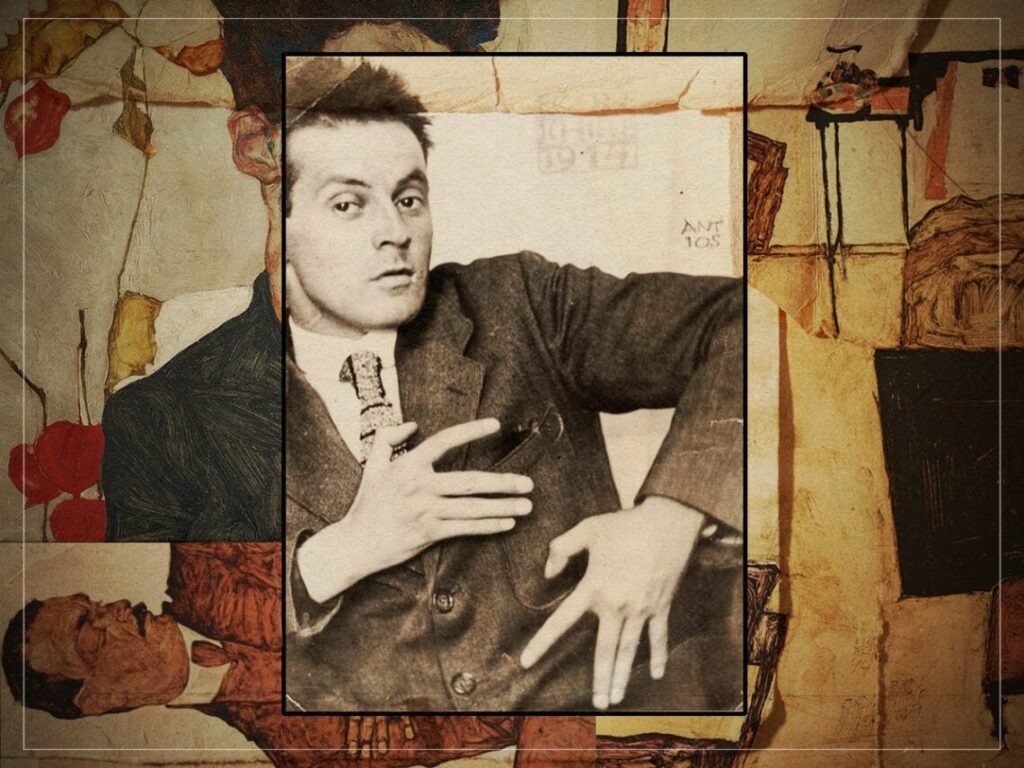
The Austrian artist Egon Schiele is known today for his harrowing portraits of hollow-eyed, sunken-faced characters. His dark body of work is celebrated today for serving as a visual evocation of his own psychological torment and turbulent life, which resonates with many as they seem so emotionally palpable.
However, at the time, his work got him into quite a lot of trouble. Schiele developed narcissism and schizophrenia, which is evident in the evolution of his paintings. Mainly placed on a stark plain background, his clothed or nude female figures were often painted in contorted positions, their multi-coloured flesh pulsating with life feverishly, yet their eyes lifelessly staring into the depths of your soul, causing a chilling effect for many viewers.
These nude female figures in erotic and submissive positions formed a large portion of his repertoire and, as a result, definitely began to increasingly raise a few eyebrows, particularly within the Neulengbach community where he lived.
According to art historian Albert Elsen, Schiele used Auguste Rodin’s continuous drawing technique to create his loose, fluid figurative sketches. This technique required constant eye contact with the life model, making Schiele’s process of drawing an intimate experience between him and his subject. Not only was that process very sexually charged, but many of the models were women he also engaged with sexually. Thus, the paintings depict a raw snapshot of heated moments before or after sleeping with them.
His models often included people he knew, for example, his sister, young prostitutes, and lover, Wally Neuzil. The pair met when they were teenagers and went to live together, spending every moment with each other. One can only imagine what the pair got up to, and his paintings of her, give us a pretty clear idea.
Schiele asked his models to lie on a mattress placed on the floor while he perched above them on a stool or ladder. Already, the act of the paintings demonstrates the sexual power struggle which seeps out of the canvas. This is ultimately what led to his imprisonment and downfall.
Although Schiele’s sexual escapades were fully in keeping with the norm for a bourgeois young man at the time, the girls were minors, and these sexual portraits increasingly blurred the lines between modelling and prostitution.
As these suspicious behaviours bubbled under the surface, causing increasing concern, the tipping point came when, in 1912, a young 13-year-old girl named Tatiana turned up at Schiele and Wally’s house, asking to be rescued from her overbearing father and to be taken in as a model. When Tatiana’s father discovered this, he got Schiele arrested on suspicions of kidnapping and seduction of a minor.
[embedded content]
Related Topics