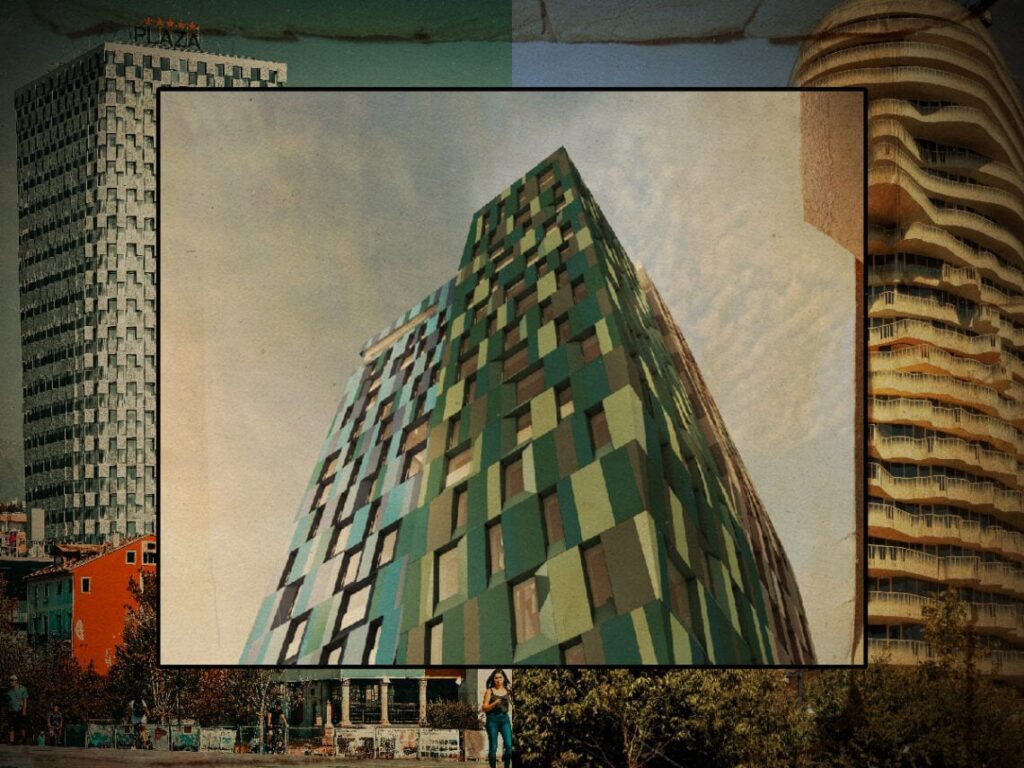
Views from Tirana: The world’s most underrated skyline
 Posted On
(Credits: Far Out / Gashi Bujar / Tom Ackroyd / Alban Tower)
Architecture is one of the most important parts of our existence that’s around us, under us and in front of us, wherein well-designed buildings act as homes purveying warmth, huge tower blocks act as boasts of creativity, and a city’s skyline can become an iconic representation of its ideology.
When you think of famous cityscapes, you’re instantly drawn to New York, the dense towers, the art deco façades, the Empire State Building and the Chrysler Building, and on the other hand, there’s London’s Gherkin and St Paul’s Cathedral, blending new and old, while the Shard punctures the clouds that hang above. Shanghai’s mix of past and present with the Bund and the Oriental Pearl Tower tells the European history of the Chinese city, while the Burj Khalifa and Burj Al Arab portray Dubai’s riches and forward thinking.
However, aside from the well-known, when we’re talking about the most interesting skylines in the world, then there’s an underrated European contender that needs to be in the discussion: the weird and wacky skyline of Albania’s capital, Tirana.
It’s not surprising that Tirana isn’t in the spotlight, as Albania only really began to open up to the wider world in 1990. Prior to that, it was isolated and under dictator Enver Hoxha, a secretive state that nobody knew much about, landing as the European answer to North Korea.
It takes a long time for perceptions to change, and gradually people are discovering the beauty of the country, the kindness of its people and the sandy beaches on its coastline, with tourists arriving to Tirana in droves and finding joy in the bizarre skyline that stands there, revelling in the mixed history.

There are many highlights, with some still under construction, and one of those is Tirana’s Rock, alternatively known as the Skanderbeg Building, a 26-storey high-rise shaped like the head of Gjergj Kastrioti, otherwise known as Skanderbeg, a national hero who fought off the Ottoman Empire.
Situated next to Skanderbeg Square, the building looks out onto the large pedestrianised space, and given that it’s a 3D representation of Skanderbeg’s skull, you get a different view of his head as you navigate around it.
Next to it on the square is the Intercontinental, a bright golden hotel block that dwarfs the Tirana International Hotel that stands in front of it, which was the only hotel open during the communist years, housing the occasional visitor who’d enjoy great facilities, with their room likely bugged by the secret services.
Echoes of that era are visible elsewhere in the form of the Pyramid of Tirana, a large brutalist structure that stands as a visible reminder of that period in history. Originally intended to be a museum honouring former leader Hoxha, it was repurposed after the regime fell and now acts as a conference centre, and at one point was used by NATO during the conflict in the Balkans, with the cold, concrete exterior reflecting the pain and colourless communist era.
Overlooking that is the Sky Tower, the top of which features a rotating bar that looks like a UFO, slowly turning to show drinkers a new view of the city at every glance, and while this gloriously kitsch building feels like a throwback, it was originally built at the turn of the millennium.

There’s the TID Tower, a metal monolith that looks mismatched with its brutalist surroundings, thanks to its elliptical-to-rectangular profile, and you have the Tirana Tower, another project by the same MVRDV, who are building the Skanderbeg Building, whose one side is a traditional tower block, but on the other it features rooms that jut out. At first, things look random, but on closer inspection, you realise the map of Albania, with the most protruding rooms reflecting the country’s peaks.
The green and blue Alban Tower stands 107metres tall and was built as the winner of a 2000s competition to add to the city’s skyline. The colours change as the sun hits them, and it’s inspired by a tree that goes from a thick trunk at the bottom to thinner branches of different lengths. It’s also an engineering marvel, forgoing traditional internal support columns and replacing them with a hollow concrete tube that acts as a load-bearing structure; religion plays a part too, with mosques and cathedrals all visible when the sun sets.
Not many countries have skylines like that of Tirana, and that’s largely down to the city’s unique context, which was initially designed by Italian planners in the 1920s and 1930s, echoing traditional Italian architecture, before it was invaded by fascist Benito Mussolini in 1939 and subsequently by the Nazis before the communist-led National Liberation Movement, led by Hoxha, seized control after German withdrawal in 1944, and the communists used architecture to showcase their power and ideology.
When independence broke out, so did the buildings, with state planners losing control as the skyline blossomed. Since then, the country elected former Tirana mayor Edi Rama as prime minister, a former artist, who has added flair to the capital, treating its skyline as a canvas on which he can rewrite the city. Tirana boasts of a varied and truly unique history that lives on through its residents and in the buildings that surround them, offering a glorious mishmash that reflects the nation’s past, present and future.
Related Topics