The Sick Man of Europe: ambiguous post-punk wanders the terrain of our managed decline
 Posted On
(Credits: Far Out / The Sick Man of Europe)
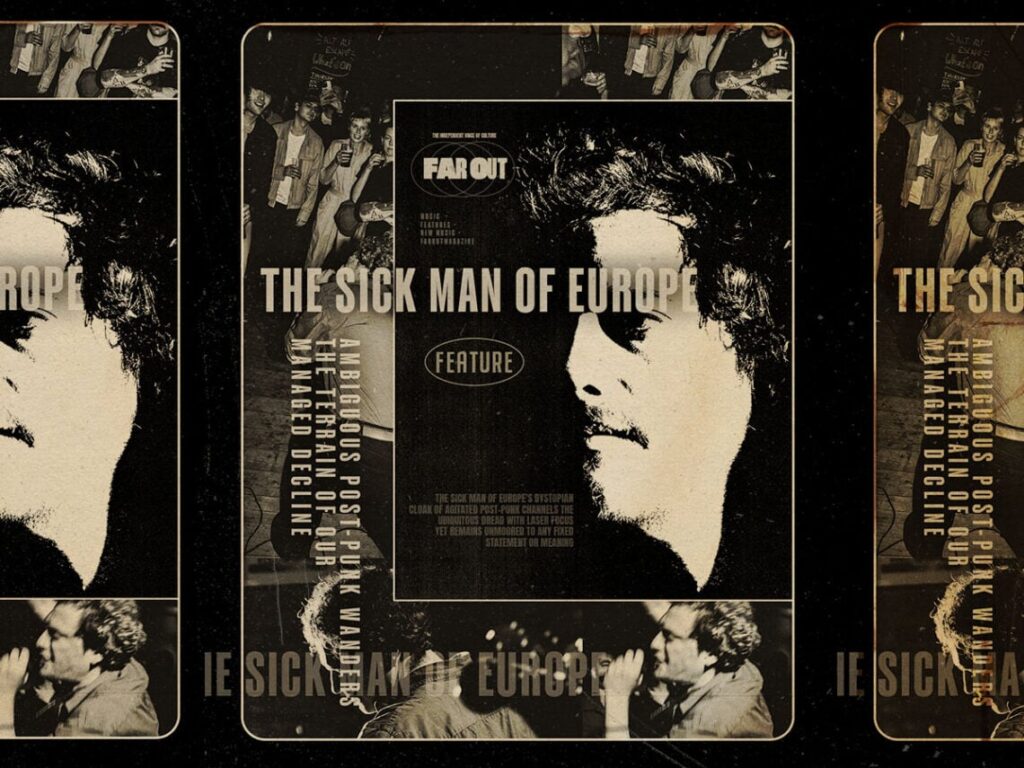
Artists often wield anonymous shrouds and concealed identities as a piece of escapist fun or, at times, tedious indulgences of an ego lost in their own hype. Perhaps a first in popular music, The Sick Man of Europe pursues his incognito presence as a force to illustrate fundamental ‘anti-mystique’, that is, to cast himself into a conduit of mass unspoken thoughts, collective instincts, and the national loss of a shared, imagined future. It’s also an act of self-preservation: “It is resistance in a time where we are forced to broadcast ourselves for all to consume, as a replacement for true human connection. We’ve been tricked. Our attention has been sold and commodified. And through this process, we have lost something very dear”.
Sometimes, when houseflies rub their legs together to clean themselves, they accidentally twist their own heads off, reflexively carrying out their grooming routine until they inevitably die of dehydration, often rolling their disembodied head between their front legs. Unthinking and unknowing, The Sick Man of Europe scores the frayed nerves and chemical adrenaline of a populace bludgeoned by wage slavery and Tesco, somatically dwelling in neoliberalism’s panicked intersections between ‘Man’ and the stifled worlds we’ve created far removed from our innate needs. From the office tie wrapped around the anxious primate’s neck just a little too tight to the sudden spike of impotent rage that overwhelms the hollowed-out London commuter, The Sick Man of Europe’s sonic reportage is fuelled with simmering, ticking urgency.
“Anxiety is a great motivator,” he pithily retorts. Shaped by contemporary rot yet cooly observing history’s spectral echoes, The Sick Man of Europe’s moniker can be traced to Tsar Nicholas I’s withering lambast against the Ottoman Empire’s creeping decline in 1833. Later, it was a label tacked onto the UK during its late 1970s era of perceived industrial chaos and economic calamity. Enshrined in Thatcherite mythology as to the inherent perils of the Keynesian big state, The Sick Man of Europe’s choice of alias dissects the hypocrisies of justification narratives and political dogmas that distort national memory and manufacture consent to suit the elite. “It’s existed ever since we started measuring our societal progression in terms of production,” he states, noting, “It’s a diplomatic slur. It’s a badge of shame. What better way is there to keep the masses productive than to make them believe that we are on the brink of total collapse?”
Gnawing wealth disparities, authoritarian clamps on civil liberties and an impending climate catastrophe would indicate that the potential collapse is a very real source of existential terror. Yet debut album The Sick Man of Europe exorcises less the political class’ distractions or cover-ups but the flagrant acquiescence to inequality. No vision, no plan, the managed decline won’t be turned around; you’re just gonna have to live with it.
Following the Moderate Air Quality EP’s aural cues, the LP gives voice to the stinging stasis’ clammy grip on the Western world. Propulsive motorik drum machines steadily course against languid basslines and pulsing sequencers. Beats and time signatures shuffle with steadfast uniformity, and The Sick Man of Europe fronts the taut, resonant minimalism with his remote, baritone croon. While seemingly inheriting a rich tradition of UK post-punk and coldwave synth projects, the artist is unconcerned with overtly honouring heroes or denying the musical and cultural conditions that forged him. “I’m not trying to replicate or subvert anything,” he asserts, “Everything I’ve seen, everything I’ve heard gets filtered and warped by the limitations of the human mind. The sonic stamp is likely blurred and faded, and I have very little control over that.”

“You’ve got to keep with the movement / An ever-growing mass / Progression is inherent, that is that / Left behind again”, The Sick Man of Europe spouts on album opener ‘Obsolete’. Uttered like media incantations, he conjures his lines like chewed-up news reports or scrambled government inquiries, the external artifice slowly supplanting one’s identity and emotional spirit. Lyrically, the record dwells in mantras, somatic repetitions, and reduced verbiage, thoughts and reverie processed like bodily functions over pretensions of poetry—an unnerving mouthpiece of the id. “Ripping through and ripping out / Oh, I’m alive / I’m alive”, The Sick Man of Europe reminds the world, and possibly himself.
“This record is the water spilling from an overflowing cup,” The Sick Man confesses. “I feel everything, usually all at the same time, and my purpose here is to document that. It builds up over time to a point where these observations need to be packed up and delivered. That’s where The Sick Man of Europe comes in.” Like a time bomb, his eponymous debut waywardly wanders its sonic and thematic terrain in search of some vestige of clarity amid a sensory overload amplified by a modern arena of broken information markets whose currency is attention over accuracy. “A shaking blob, an awkward mess / a formal man in awkward dress”, he murmurs on ‘Slow Down, Friend’, the closest the album gets to an arm of solidarity.
Such terse, potent anti-rock creates a surprisingly gripping show. Capturing ephemeral electricity, the artist’s febrile austerity takes on new life on stage, his skeletal arrangements and sinewy synth-soaked bite react elementally to the live dimensions of the crowd, snaking his way through the audience like a contagious spark of lacerating psych. “With repetition comes clarity, and with clarity comes weight,” he cryptically alludes. “On the stage, I’ve already repeated these words hundreds of times, in many different places and in front of many different faces. Each time, the meaning gets compacted and the intensity of the message builds into something beyond our control. It’s evolved into more of an exposure than a performance”.
There’s no mask or alter-ego at play, but an exercise in disregarding identity and our indulged statuses or perceived stature, lost in modern atomisation. “The Sick Man of Europe is more of a reduction, he states. “What remains when biography and vanity are boiled away. The idea of a body, a face, or a personality just detracts from the words that are told. This is not my story. I am a spokesperson.”
The Sick Man of Europe‘s dystopian cloak of agitated post-punk channels the ubiquitous dread with laser focus yet remains unmoored to any fixed statement or meaning. The Man just is, lurking in every office cubicle, emanating from every suited middleman, the coagulating scab of perma-status quo, the private horror that nothing can change, the unnerving yet authentic soundtrack to our strangled, focused-grouped, data-harvested times. At its core, however, ambiguity can invite a change of our paths for the better, despite such distant reach of the distress light: “It’s a commentary on both personal and societal dissonance in a time where the march of untethered technological advance is creating nauseating global shifts. It’s a call in the dark, it’s an echo in the distance. It is human decay, it is rebirth.”
[embedded content]
Related Topics
The Far Out Music Newsletter
All the latest music news from the independant voice of culture.
Straight to your inbox.