May 1968: When indie songs changed France forever thanks to an uprising
 Posted On
(Credits: Far Out / André Cros / Bibliothèque nationale de France)
Pop music has found itself the soundtrack to many a social upheaval or political earthquake across the 20th century and beyond.
The hits pumped out by the Motown and Stax soul factories proved an essential score to America’s Civil Rights struggle and the era’s Black experience of a nation engulfed in racial injustice. 50 years later, Ramy Essam’s ‘Irhal’ proved so consequential that many young Egyptians saw his rousing political anthem as instrumental in accelerating Hosni Mubarak’s abdication as president and helping fan the revolutionary flames across the broader Middle East during 2011’s Arab Spring.
The 1960s’ counterculture yielded a Western explosion of anti-establishment feeling unseen since the European revolutions of 1848. Sparked by the fierce divides drawn between the day’s generations, the liberal youth movements flaring up across the world all shared a loosely joined agenda of confronting conservative mores, imperialism, and capitalist greed to the paranoid panic of the political class. Such hotbeds of furious organising would surge potently from universities and campuses around the world, spilling into the world of left-terror from The Angry Brigade’s UK bombing campaign to the Marxist Red Army Faction’s armed guerrilla campaign in West Germany.
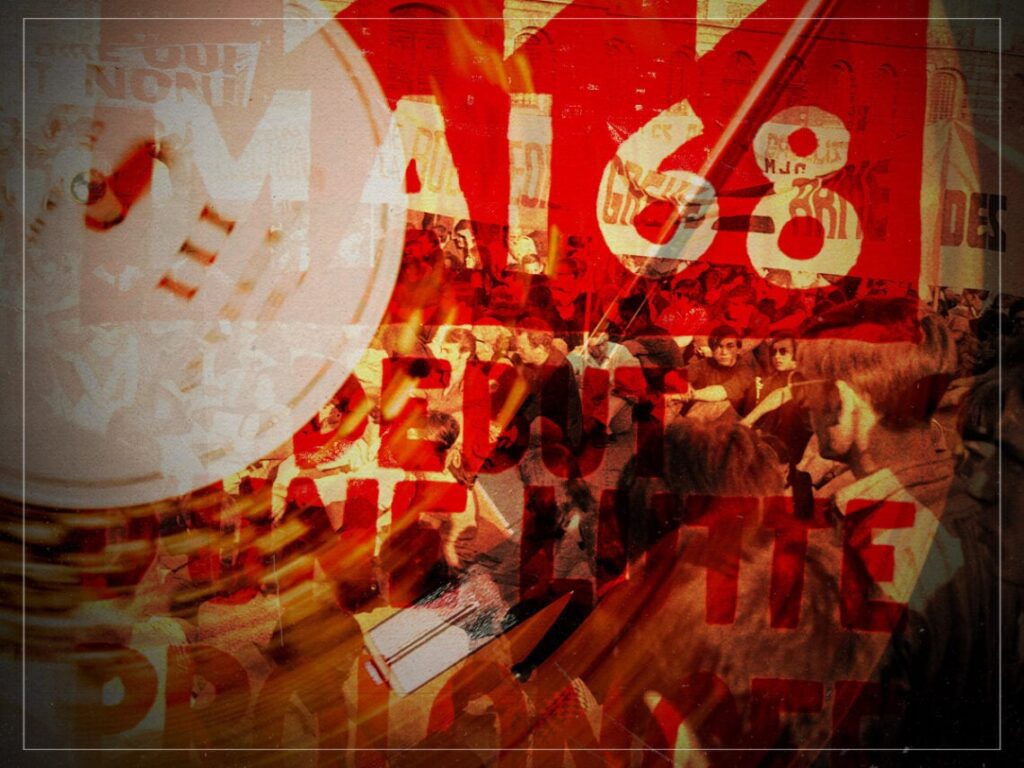
Such political fervour swiftly spread to France. Born from working-class dissatisfaction with economic stagnation and a student-led challenge to the nation’s traditional norms, protest and civil unrest engulfed the Fifth Republic across May 1968 with such intensity that it nearly toppled Charles de Gaulle’s presidency. While not triggering an all-out revolution, the former war general resigned the following year, leading to greater public spending by the state, and concessions being made on pay and conditions. Romanticised in leftist circles while standing as a cautionary tale of anarchy on the right, the May ‘68 protests loom large in the French political consciousness.
As with much of the countercultural wave that swept the world, civil unrest and pop music went hand-in-hand. Just as the original 18th-century revolutionaries sang ‘La Carmagnole’ to celebrate the attack on the antiquated ancient régime, contemporary chart-toppers found themselves forever associated with the May ‘69 riots. As laid out in Francophone expert Claire Fouchereaux’s ‘The ‘Darkening Sky’: French Popular Music of the 1960s and May 1968’ paper for The University of Maine, certain hits of the day expressed the youthful passions that fuelled the political turmoil during that chaotic month.
Key selections include folk rocker Antoine’s ‘Je dis ce que je pense, je vis comme je veux’ lambast of French social hierarchies, Christophe’s ‘Excusez-moi monsieur le professeur’ take-down of the education system, and even the mighty military, still holding strong in allegiance to de Gaulle and stained with the colonial terror meted out on Algeria, found itself in Pierret Perret’s lyrical target with ‘Le service militaire’. Explicit attacks on the capitalist system also found their way on the French SNEP charts, Les Missiles’ ‘Sacré dollar’ and Henri Salvador’s ‘Le Travail c’est la santé’ speaking to a proletarian sensibility rearing its head, and ‘Et moi et moi et moi’ by Jacques Dutronc looked to the wider world in its condemnation of global inequality.
“…all of these songs’ resemblance to particular key parts of May 1968,” Fouchereaux states, Opposition to authority or hierarchy, anti-capitalist attitudes, a rising consciousness of the outside world, and anti-war sentiments, popular French songs of the 1960s seem to foreshadow the positions and ideas that would later erupt into May.”
With pop music being one of the 20th century’s most towering art forms, the power of a hit single can rouse imagination, expand political possibility, and provide the spiritual marching fuel to soldier on against all odds. As socialist folk singer Pete Seeger once allegedly said, “I always believed that the right song at the right moment can change history.”
[embedded content]
Related Topics