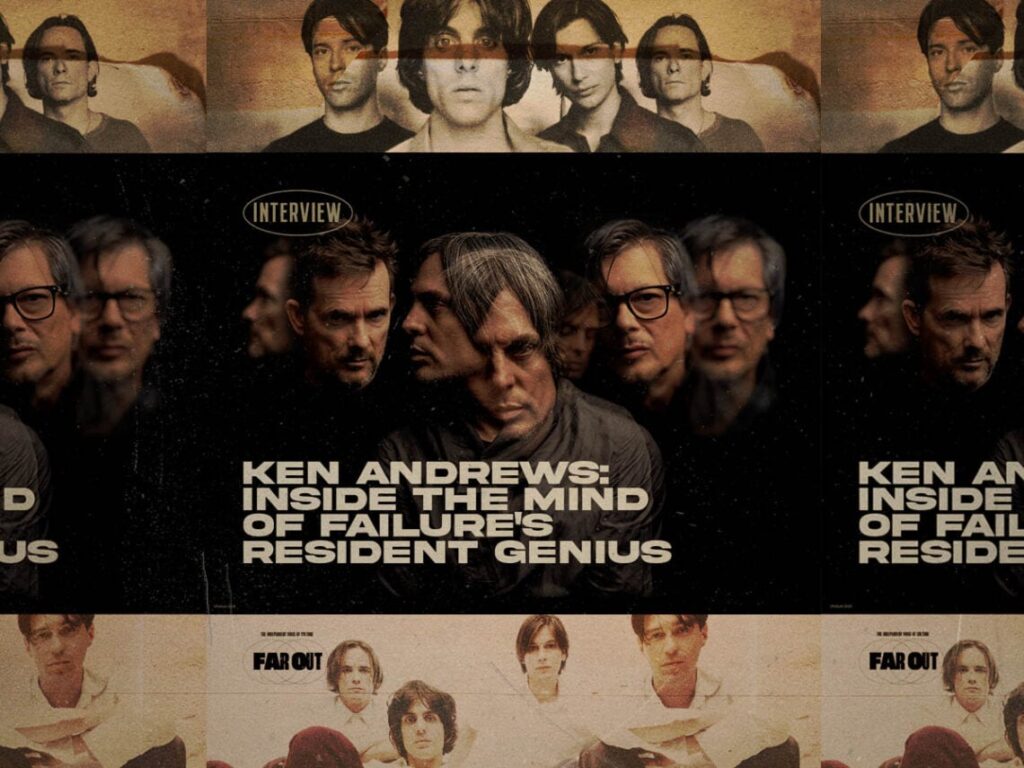
Ken Andrews: Inside the mind of Failure’s resident genius
 Posted On
(Credits: Far Out / Grandstand Media)
Failure has often been categorised as “your favourite band’s favourite band”. From the moment they began life in the late 1980s until their tragic break-up and eventual reformation in the 2010s, they have always been paving the way for all things heavy, atmospheric and more grandiose than anything else in rock and roll. And now with a new documentary about their rise, fall and eventual redemption, Ken Andrews is nothing but grateful about being able to still be making music that resonates with people over the years.
Despite never gaining a foothold in the industry at the time, records like Magnified and Fantastic Planet have taken on a new meaning for the next generation. There might not be any way to put them in a box, but the minute that someone hears anything from ‘Stuck on You’ to ‘Blank’ to ‘The Nurse Who Loved Me’, they’re hearing a story being told between Ken Andrews and Greg Edwards.
Both of them would have made for the resident genius in any other group, but part of the beauty for Andrews was always working off each other to find the next strange sound, saying, “I think we gravitate towards things that are out of the ordinary and are kind of repelled by things that are ordinary. If it sounds like something you’ve heard before, it normally gets nicked pretty quickly. We’re constantly looking for chord changes, sounds, whatever, that just have a little bit of ‘What is that?’”
While those strange sounds were enough to capture the attention of legends like Maynard James Keenan of Tool and production guru Butch Vig, the group always felt like a band slightly out of time. Some of their tunes may have fit in with the grunge scene, but they were never looking to be lumped into any specific category. It was always about the energy they created, and when Fantastic Planet hit, it rewrote the book on what their sound could be.
Many chord tones had connective tissue to the rock and roll that came before, but it would always take a different turn. Andrews and Edwards were definitely the Lennon and McCartney of the group in some sense, but in terms of their harmony, they went to the Syd Barrett school of messing around and seeing where the music would take them rather than writing the typical pop ditties.

Having been a part of the film world before, the frontman was taking cues as much from film scores as he was from his record collection, saying, “We were constantly watching movies while making records, which is pretty common, but we did it a lot. During Fantastic Planet, I bought my own laser disc player. I always had five or six rotating and [the movie] Fantastic Planet. We had a mixture of arthouse stuff and pop films, [and] it was either playing in the background or we would watch, and that got into the bones of the record.”
And you can hear that from the minute that the record starts. From the otherworldly keyboard textures to the Dinosaur Jr fuzzy guitars, this feels the closest that the 1990s ever came to making anything with the same size and scope of something like The Wall. Even the segues (something which would be considered fluff on any other record) manage to sound like meticulous extensions of their ideas, as if they are ballads being beamed in from the other side of the galaxy.
The album is definitely one of the most finely aged products of the late 1990s, but it never seemed to meet the moment like it should have. ‘Stuck On You’ may have been the kind of single too big to ignore by their standards, but this wasn’t a record meant to be full of hit singles. It was meant to come at you in waves throughout the record.
Like all bands, they weren’t without their drama, and the real heart is a story of Andrews trying to work with Edwards amid his drug-induced haze. His partner was not taking care of himself, and if he wanted to make sure his friend got to see another day, he would trade any new song to see him healthy. In the meantime, a few more people were tuning into their strange frequencies.
Aside from people like Keenan and Vig, everyone from Jason Schwartzman to Paramore’s Hayley Williams was knocked out by what they heard on their three records. Andrews had since graduated to being a producer and mixer at that point, working for everyone from Paramore to Blink-182, but if he even thought about putting the band back together, he knew it would have to be for the right reasons.
“Picking up where we left off was really important to us. We just wanted the record to be taken seriously”.
Ken Andrews
And once Edwards cleaned up his act, their reunion in the 2010s wasn’t about them cashing in on anything. It was to see if they still had the chops to bring things full circle, and while there were many opportunities for things to go sideways, The Heart is a Monster was never a half-hearted cash-in. This was a band getting resurrected before our eyes.
It didn’t come without some pressure, though. By that point, Fantastic Planet had ballooned into one of the greatest underground classics of the 1990s, so they had to make sure everything was right, saying, “The hard thing about that record was it was coming after an album people revere. There was the pressure of still sounding like that band, but also push forward a little bit and not have it be a clone.”
But on the first listen to ‘Mulholland Dr’, Andrews had spent all that time making himself a better song craftsman. The guitars were as thick as ever, but there was also a tunefulness behind everything that made them feel more in line with the dark soundscapes that Robert Smith would have thought of back in the day.
And now that there were more fans to appreciate it, Andrews was knocked out by the people who took their sound even further. Amid all of the celebrity cameos in the documentary, Andrews was most knocked out by Williams’s story, saying, “I met her in the early 2000s and I knew they covered one of our songs, but I had no idea that Fantastic Planet was a really important album for her in wanting to do music. That was an important record for her, wanting to be in a band rather than be a solo artist. It made her want to be in a band, and that was a full-circle moment for me.”
As the band continues to push on through the good times and the bad, they’ve never forgotten the importance of making their own noise. And now that people have been interested in more flavours of music than before, it’s given Failure freedom to do right by them, as far as the frontman is concerned, saying, “We have tried to make our own sound and at this point, we’re not being compared to other bands as much as we are to our body work, which feels good. I never feel like people understood it then, and now I feel like they do.”
While Andrews described his band as “the right band at the wrong time”, history has shown that there will always be room for people like him willing to push the envelope a bit further in music. It’s not always easy, and they might have to go through a lot of red tape to find their identity, but as it stands in the documentary, Failure made one of rock’s ultimate comeback stories by being the right band in it for the right reasons.
Related Topics
The Far Out Music Newsletter
All the latest music news from the independant voice of culture.
Straight to your inbox.