Is there a future for festivals without boycotts?
 Posted On
(Credits: Far Out)
A summer filled with live music is the highlight of the year for many. Beer-soaked memories and dodgy tan lines are the ultimate indication of a good time had by all across all festivals on the European continent.
Of course, there was a time, not so long ago, when we thought these kinds of events might never be physically possible, but through a worrying few years and only just avoiding the brink of decimation, the industry has found its footing once again. Yet, as the world tries to move on, there’s an ever-deafening march that threatens to drown out the noise. It moves to the beat of “Free, free Palestine!”
The harsh reality is that festivals and the live music industry have always relied on corporate investment to remain afloat, but particularly so in the aftermath of the pandemic. That undoubtedly steadied the ship for a while, but the trouble is that just a few years down the line, those very sponsorships are now proving to be more problematic than they are a lifeline.
As more and more corporate ties are exposed in everything from the Israeli regime to fossil fuels, deciding whether to take the ethical route and strip their sponsorships, risking a rapid sink into financial quicksand, is proving a tedious dilemma for festivals. Meanwhile, artists and fans continue to boycott en masse, and it doesn’t seem like something that will go away anytime soon.
There are many possible examples to cite, but Boardmasters Festival, kicking off this weekend down the Cornwall coast, is one of the most current and prominent taking points. A number of previously scheduled acts, including the Menstrual Cramps, have pulled out of their appearances due to the festival’s refusal to stop “platform[ing] Israeli people”, with a number of surfers from the country still set to take part in the event.

Not only this, but with investments in Boardmasters from the likes of its owners Superstruct Entertainment, which has supposed links to KKR and Israeli arms dealers, the festival has undoubtedly become the latest big target in the Boycott, Divestment, and Sanctions (BDS) movement for Palestine. They are, of course, not the only ones—Sónar, the electronic music festival in Barcelona, faced similar backlash when it was held in June this year, forcing the organisers to declare their stance that they clearly and unequivocally condemn ”the genocide committed against the Palestinian people” and are in a process of dissociating themselves from investors.
The BDS employs boycotting as “they are strategic, time-sensitive and targeted” to call out investors with connections to music festivals, as a means of taking “targeted action at a strategically identified company that the Palestinian community have called for solidarity on, and that organised musicians have the power to do something about”. After all, this is more than just signing an open letter or donating a few hours of your time to some ultimately meaningless charity single—it’s putting your money where your mouth is, and taking the hit to prove that you mean what you say.
Naturally, actions speak louder than words, and only time will tell if, in 2026, this will have any effect on the festivals moving forward. But the point is that these organisations are now acutely aware of the public scrutiny over their previously hidden corporate investments and the political role they play in society, perhaps more than ever. Critics will argue that it creates a cultural gulf, as art needs investment to survive, and boycotting is simply speeding up that death, but there are suggestions that this does not have to be the case.
Take The Great Escape as a case study, where last year the Brighton festival became the primary live music target of the BDS due to its sponsorship from Barclays. In a letter to artists imploring them to drop out of the event, the BDS said:
“There is no festival without the artists. Our labour is our unique leverage to put pressure on the festival to drop Barclays, this is why it’s a powerful gesture to drop out of the festival.”
The BDS
And the thing is, it worked. In October, the festival broke its partnership with the bank due to public and industry pressure, proving that, through all the noise and discourse, boycotts really do have a point.
Using festivals as one cog in the machine against the general societal boycott of Barclays can lead to seismic effects. Statistics from the Palestinian Solidarity Campaign, linked with the BDS, say that over 5,000 people shut their accounts with Barclays throughout the course of 2024, with another mass closure event planned for the end of September this year. Sometimes, one person taking a stand may feel like a drop in the ocean, but it all cumulatively snowballs into a mammoth global force.
This is obviously a major win in terms of Palestinian solidarity, but it begs the question more generally of how boycotts can be used against festivals in the future to relay political messages. Beyond the immediacy of the genocide in Gaza, there are many other issues, from climate change to other conflicts, which demand cultural attention in ways beyond what a boycott can achieve.
In certain situations, as uncomfortable as the reality is, artists will need to stand up on those complicit stages to deliver a message of truth and activism, as a more potent way of diverting their labour. The Russian war in Ukraine exemplifies this, with a number of Ukrainian artists making the principled decision to still perform at this year’s Sziget festival in Hungary, despite the country’s complicity with Russia.

The horrific reality is that in the last three years of conflict, nearly 20,000 Ukrainian children have been forcibly removed from their families and homes by Russia, and largely, the most effective way of providing a platform to these crimes is not to avoid places with Russian influences, but to stand on top of them and tell the searing truth, such as on stages at Sziget.
There’s also the fact that although boycotts may seem like the morally ethical high ground, they aren’t materially changing the situation in Gaza without a substantial monetary donation behind it, which is not often the case when artists are pulling out of festivals and other such events. It was the point made by Swedish hardcore band Refused when they still decided to play a range of festivals backed by KKR this summer, and released a lengthy statement on Instagram in May explaining why.
“Being morally superior doesn’t put food in the mouths of starving Palestinians,” they reasoned, adding that their boycott, as a smaller band, “wouldn’t make headlines”. They also revealed an unspoken truth, which is that festivals themselves are often powerless in who their investors are, seeing as they are often managed by large conglomerate companies. In fact, a number of festival organisers are making huge donations to Palestinian causes behind the scenes in an attempt to readdress the balance.
As such, it’s worth remembering that beacons do have their place just as much as boycotts, and it’s mostly dependent on the circumstances as to which one is more effective. As we move into a space of greater social awareness about countries, conflicts, corporations, and dictators, there is an argument to indicate that the two should be used as a tool hand-in-hand with one another, but how this shapes up as the world continues to evolve is, as yet, anyone’s guess.
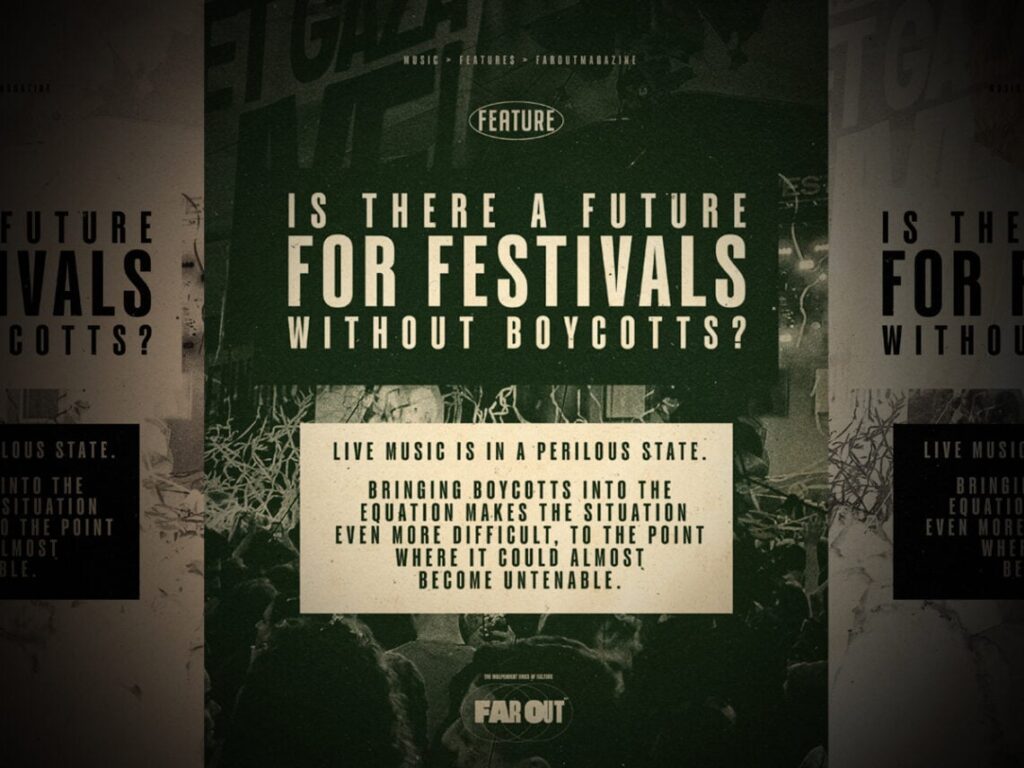
In a general sense, live music is in a perilous state. Then, bringing boycotts into the equation makes the situation even more difficult, to the point where it could almost become untenable. No one can deny their power and vital importance in the current politically conflicted landscape, especially in relation to Palestine, but the truth is that without a radical overhaul of the corporate investment system, festivals aren’t going to be getting rid of their links anytime soon.
On the one hand, the issue is simple—boycott festivals until they stop their investors with links to genocide. On the other, the implications are myriad and endless, with the threats to festivals thousands of miles away not ending with any fragile ceasefire agreement or end of a conflict in sight.
[embedded content]
Related Topics