“I always do the fuck I want anyways”: Al Jourgensen reflects on 30 years of Ministry’s squalid ‘Filth Pig’
 Posted On
(Credits: Far Out / Ministry / Paul Elledge / Doug Freel)
It’s now 30 years since industrial juggernaut Ministry dropped Filth Pig, one of the biggest creative gambles of their 45-year career, and an album that turned its back on serious commercial heights in favour of an all-too-real bottling of the demons that had finally caught up with their longtime frontman.
Such a U-turn was nothing new. Since their founding, captain and producer Al Jourgensen had been steering the Ministry machine through a gamut of evolving styles, each album clawing at some new sonic terrain, fuelled by restless artistic intuition and sheer bloody-mindedness to avoid categorisation. Pig-headed, some might say. But fans and critics weren’t prepared for just how oppressively uncompromising Ministry’s sixth LP conjuring would stand in contrast to the massive Psalm 69 seller, swapping its highly charged mechanised pummel for Filth Pig’s hellish backwaters doom attack.
“We just really didn’t care, because at the time, that’s the only type of music that we were capable of doing,” Jourgensen fires off to Far Out with characteristic candour. “I always do the fuck I want anyways.”
‘Doing the fuck he wants’ served Ministry more than well across the preceding decade or so. Seemingly possessed with King Midas’ touch, Jourgensen was able to inversely pursue a sound further and further away from pleasing the Hot 100 while still shifting respectable units. As we all know, Ministry made their LP debut via 1983’s With Sympathy, an album wholly indebted to the synthpop new wave dominating the charts during MTV’s Second British invasion – faux English accent an’ all. Yet, straightjacketed by the Arista major label and drifting away from his post-punk burnishing, Jourgensen looked to hardcore punk and the emerging EBM belligerence scoring the darker corners of European dancefloors for a sorely needed new direction.
Decamping to London and learning the studio ropes under the tutelage of On-U Sound Records’ Adrian Sherwood, 1985’s Twitch follow-up cut a meaner, more mutoid take on electronic music, slathered with the classic Ministry penchant for warped media samples. Three years later, harder guitars and the signature effects ravaged vocals would churn across The Land of Rape and Honey’s scorched cyberpunk earth with longtime co-member Paul Barker, afforded extra sonic heft with the new Sire label’s very generous bestowing of the handsomely-priced Fairlight CMI digital synthesiser to the pair’s Chicago Trax Studios.

With Rigor Mortis’ Mike Scaccia lending his thrash guitar chops to 1989’s The Mind Is a Terrible Thing to Taste, the stage was set for Ministry’s alternative metal domination. Over a decade after their inception, 1992’s Psalm 69: The Way to Succeed and the Way to Suck Eggs – or ΚΕΦΑΛΗΞΘ to give its official, occultist title – thrust Ministry to the peaks of MTV fame, the hooky but apocalyptic barrage of machine heavy powering the mammoth ‘NWO’ and ‘Just One Fix’ singles saw the band pulled from the underground and touring on that year’s Lollapalooza plus featured on Beavis and Butt-Head. Ministry weren’t a cult band anymore.
“It was hard to handle,” Jourgensen confesses. “I wasn’t expecting it, and I didn’t take it well, you know, heavy drug usage to escape.” Such a chemical retreat reflected the growing unease within the Ministry camp surrounding their new high-profile and the greater pressures placed on them for the hypothetical LP follow-up. “Whoa, whoa, whoa, we didn’t want to get famous this fast!” he recalls, casting his mind back to the early 1990s’ madness.
Adding, “Let’s just slow your roll a little bit. Let’s pump the brakes, let’s take some time, and do something that’s an accurate reflection, instead of trying to manufacture a Psalm 70 to be exactly the same. That wasn’t interesting to us.”
After some time away with the psychotropic Revolting Cocks side-project, Ministry returned to the studio with every intention to cut a markedly different beast than their prior MTV winner. Out were the programmed percussion and collaged sample slither, in came gargantuan slabs of stoner doom engulf, dusky harmonicas, and lyrical reportage turned inward rather than the geopolitical tumult anchoring previous records.
Shrouded in a leaden, opiate fug and putrid self-dissection, the Filth Pig sessions wrestled some of Ministry’s darkest yet curiously eclectic material. Casting his mind back to the album’s numbers, Jourgensen praises cuts like the bloodshot ‘Lava’s “snapshot of where I was at the time,” chiefly concerned with the feverish race of heroin through the veins. ‘Reload’ and ‘Crumbs’ stand tall to the Ministry frontman for their “really quirky” time signatures, the smothering title track offers an illustrative vignette on life as a junky – ”sitting cross-legged in your own vomit” – and album closer ‘Brick Windows’ is granted the peculiar plaudit as “almost Britpop.” Filth Pig is also the centre of arguably Ministry’s finest ever moment, the thunderously haunting ‘The Fall’s cascading swallow of cavernous percussion and phantasmic pianos so stirring Jourgensen checked the piece as the number he’d select for his funeral send-off.
Then there’s the audacious Bob Dylan cover. Leftfield renditions of rock and pop’s big names, as well as from the punk underground and industrial world, pepper Ministry’s records, as any fan will know. But there’s little dispute that the band’s best stab at another’s songbook is Dylan’s delicate and lilting ‘Lay Lady Lay’, twisted into a heaving explosion of lysergic, strung-out slack befitting Filth Pig’s aural ruin. Finding out Urge Overkill had already cut their take on Glen Campbell’s ‘Wichita Lineman’, which initially piqued Jourgensen’s cover fancy, Jourgensen and a reluctant Barker would feed Dylan’s 1969 classic through the Ministry filter, birthing the album’s second single and standing tall as one of the songsmith’s finest reimaginings.

Despite only attempting to play live a couple of times – “It sounded so shitty that after the second one, I went back to the dressing room, trashed the dressing room, and said ‘we’re never doing this again’” – an acoustic jam of ‘Lay Lady Lay’ during Ministry’s 1994 performance at Neil Young’s Bridge School Benefit prompted a plaudit from the vagabond himself, “Neil Young hands me the phone, and it’s Bob Dylan going, ‘You own this song now. Nice job.’ Wow. So vindicated.”
Turmoil hung in the air of Filth Pig’s gestation. Band members were scarpering, Barker briefly calling it quits before returning, while old comrade and drummer Bill Rieflin parted ways for good after ten years in the Ministry ensemble and was replaced by Scratch Acid’s Rey Washam. Taking its toll on Jourgensen was the surrounding stresses of a divorce, the upending shift from his long-held Chicago base to Texas, and his incessant smack habit, an addiction also sticking its hook into guitarist Scaccia.
“Well, you know, I was unreliable,” Jourgensen states candidly. “I take full responsibility. I would sometimes just disappear for three, four days during recording and be stuck on some crack house’s couch.”
When the drugged AWOLs became too frequent, Jourgensen found himself lumped with Filth Pig’s growing burden. “They all just got sick of that nonsense,” he further said with the rigour of someone who’s clearly spent time processing such a dark chapter. “So eventually, for the last half of that record, I did it on my own, even my engineer quit. Everyone quit because they just thought for sure I was going to be dead, and so I stayed alive just to piss ‘em off and finish the album by myself. And then after turning in the album, Barker just went, ‘I can’t believe you’re alive, let alone you did this.’”
The very album title made clear what to expect, albeit with a spike of Ministry’s ever-present acerbic humour. After Revolting Cocks’ tour across the UK in early 1991, reports of inflatable sheep sex imitation on stage, coupled with Gwar’s shlock horror violence around the same time, prompted Tory MP Teddy Taylor to dub the two bands as “filthy pigs” in the House of Commons when lambasting the arrival of such corrupting depravity from across the Atlantic. Otherwise, ‘filth pig’ proved a succinct moniker for Jourgensen’s lifestyle amid the sessions.
“The rest of the band was basically saying that that’s what I was behind my back,” Jourgensen curtly reflected on his notorious nickname. “I would go four or five days forgetting to bathe, brush my hair, brush my teeth, strung out, missed studio sessions”.
“I was a fucking mess, man. You know, I’m not proud of it.”
Al Jourgensen
Through fracturing bandmates and dope sickness, Filth Pig was finally handed to a fatigued Warner Bros, who were less than pleased with what landed on their label desk. “Oh my god, the record company hated it when we sent in the masters,” Jourgensen looks back with a wry smirk. “They were really debating whether they should even release this or not.”
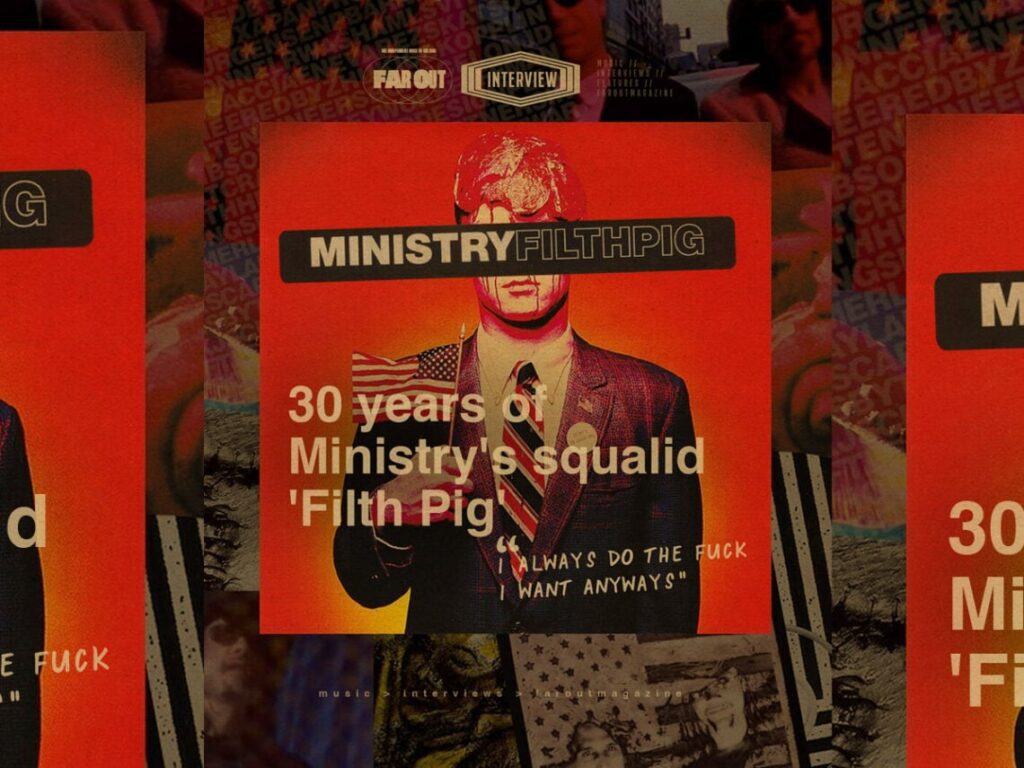
Even the cover got up Warner’s nose. Shot by frequent band collaborator and art designer Paul Elledge, the stark profile of a young suited man holding a Stars and Stripes flag and a bloody slab of meat on his head did little to assuage the label’s anxieties. “I basically sent them a decapitated pig’s head via FedEx, maggots crawling all over it and everything,” Jourgensen reveals, echoing prior shenanigans when facing objections from Sire over the artwork to 1988’s The Land of Rape and Honey, resulting in the head of a road-killed deer presented to the art department instead.
“And I said, ‘Well, take a picture of this and use this as your cover.’ And they were just not having it. They were tired of my bullshit, and I was tired of theirs.”

Finally acquiescing, Warner Bros let loose Filth Pig to the world January 30th, 1996, to a hard rock and metal climate rapidly shifting away from Psalm 69’s Lollapalooza heyday. Although peaking higher on the Billboard 200 at number 19, and much-loved among the alternative vanguard at the time, Filth Pig’s drop landed when much of the metal scene began to curdle into the nu-metal silliness that would dominate MTV by the decade’s end, a trend Ministry had no intention of capitalising on.
“It really had no influence or influx on us. As a matter of fact, it’s quite the opposite,” Jourgensen says. “We just minded our own business and did what we could, do one foot in front of the other, just trying to make it alive through the album, let alone caring where the metal genre was going or whatever. I didn’t even know we were metal, but somebody told me, I’m like, ‘OK, I guess we’re metal.’”
Yet, as the frosted-tipped buffoonery of the early 2000s swiftly aged like milk, Filth Pig’s mark on alternative rock only began to grow. Ministry themselves had undergone big changes, Barker leaving after 2003’s Animositisomina, and Jourgensen steering his now sole band through a more speed-heavy assault across the decade, but Filth Pig and its accompanying Sphinctour live album would almost match the glory days of In Case You Didn’t Feel Like Showing Up’s grate fencing seizure in the eyes of certain fans, many a YouTube comment under the various Sphinctour clip uploads declaring the era as Ministry’s fiercely artistic high point.
To celebrate the 30th anniversary, and after years of avoiding the album’s dark shadow, Ministry will be performing Filth Pig in its entirety at this year’s Sick New World Festival in Las Vegas and Texas, followed by six shows dedicated to material across Filth Pig and its acidic successor Dark Side of the Spoon.
Burying the hatchet with his old work is nothing new to Jourgensen, having finally tackled his synthpop past with The Squirrely Years Revisited and select With Sympathy numbers making their live presence after as much as 40 years buried in Jourgensen’s skeleton closet. Corralling a live team with now Ministry veterans Paul D’Amour from Tool, frequent Killing Joke keyboardist John Bechtel, and former guitarist for Madonna, Monte Pittman, Jourgensen feels confident that Filth Pig’s corrosive energy will be translated effectively after all these years.
“I mean, I feel embarrassed that I’m the worst person in the band,” he laughs. “But I’m also the ringleader. As far as talent-wise, no, this band is bar none. They’re amazing.”
While Ministry have teased hiatuses and ‘final albums’ as early as the late 2000s, Jourgensen makes clear he’s sincerely calling Ministry a day after LP number 17, the first with Barker back in the studio since he left. Expected to be out in March and following a tour playing the full gamut of Ministry’s lengthy oeuvre – ”We’re definitely not doing sausage festival season,” Jourgensen affirms, his term for the lunkheaded metal circuit – the seasoned frontman intends to leave the music business behind to pursue an altogether different career path.

“I just want to be a simple goat herder,” Jourgensen reports with sincerity. Describing with enthusiasm Los Angeles’ handsome compensation for managing fainting goats, Jourgensen doubles down on his commitments to live a life far removed from Ministry or even the plethora of orbiting side-projects. “If anyone asks me, or if they spot me in a grocery store or something, I’m just gonna go, ‘I always get that a lot. I know they say I look like that guy, but I’m just a simple goat herder, man. I was never in a band, no, the only thing I play is goat bell,’” before proceeding to mimic a tiny goat bell to the camera.
“I’m taking my life back,” Jourgensen adds. “I found peace. I found inner peace. And I don’t want anything…let me just get this last record right and make it as Ministry as it can be, and then I’m done. I’ve done my job.”
As Ministry looks set to close for good, Jourgensen has gleaned a zen satisfaction through the tumult of the music industry and the lessons learned as a former addict to judge his work on the merits of their burnishing within the many episodes of his life. When pressed, Jourgensen places Filth Pig around the top five of his personal Ministry ranking, and expresses quiet pride in the record’s growing esteem among fans and alternative rock more broadly.
“Filth Pig is a snapshot of all the turmoil that was going on at the time,” he says. “So, I mean, it makes sense to me, but to other people, I’m sure they’re just like, ‘What is this?’, you know, but it’s kind of an album that that it kind of grows on you when people first heard it. They hated it, and now it’s considered a classic Ministry staple.”
Ministry boast greater albums, and indeed more defining albums, but no record in the industrial titans’ body of work peeks into such a visceral core as Filth Pig, a grippingly raw sludge metal diary entry scoring low ebbs and drug highs while also somehow pointing to how creatively intrepid hard rock can be amid its heroin-induced stupor. After 30 years, Filth Pig’s standing as Ministry’s most candid entry only grows with greater certitude, an LP that leaves an intoxicating residue demanding repeat listens in an effort to understand its knotty, infernal dwelling.
“We just took a Polaroid snapshot of the way things were, and that’s how it came out,” Jourgensen concludes. “Pretty dismal record, but I like it.”

Related Topics