How did Michelangelo paint the Sistine Chapel ceiling?
 Posted On
(Credits: Far Out / Richard Mortel)
Some five million people flock to Rome each year to visit Michelangelo’s greatest work, the most iconic example of Catholic iconography and Renaissance painting to exist. However, only a few know that this work was the first large-scale painting project by the artist, who had initially trained as a sculptor.
Indeed, the Sistine Chapel has been celebrated since its completion; however, the process of executing the 12,000-square-foot painting wasn’t too smooth sailing. When Pope Sixtus IV commissioned the chapel in the late 1400s (hence the name ‘Sistine’), Michelangelo hadn’t fully realised what he was getting himself into. The project would take four years and require multiple re-applications of paint.
Between September 1510 and the summer of 1511, Michelangelo halted work on the Sistine Chapel ceiling due to a dispute over payment for the completed work. In August 1510, Pope Julius II, the new pope, left Rome to lead a campaign to retake Bologna. Although Michelangelo made two trips there to resolve the issue, the matter wasn’t settled until several months after the pope returned to Rome in June 1511.
The painting process was additionally interrupted several times due to mould infestations—when Michelangelo had to repaint portions just a year after he had started—and sheer exhaustion. Contrary to popular belief, Michelangelo didn’t paint lying down; rather, he built a special scaffolding whereby he would paint standing by craning his neck, causing an enormous strain on his body.
The chapel walls had already been painted by multiple early Renaissance artists, such as Sandro Botticelli, Domenico Ghirlandaio, and Pietro Perugino. In fact, some of their works still remain. But Michelangelo was brought in to give it a long-overdue ‘glow-up’, so to speak. The chapel was going to be private to the Pope, with its location being the papal conclave. It is the site where a new pope is elected by the College of Cardinals through the most important ritual, and which has seen the continuation of the practices of the Catholic church since the 1100s.
The painting process began with Michelangelo and his assistants designing full-sized sketches on paper called ‘cartoons’. These outlines would then be transferred to the plaster through a process called ‘pouncing’, where holes which formed the outlines of the figures would be poked into the plaster and then dusted with charcoal so that they were visible and formed paintable guidelines.

Galleria Palatina)
Then, the Fresco technique was introduced, which meant applying the paint to a surface of wet plaster for the painting to last and retain its vibrancy. This meant working really fast because the plaster would only stay wet for so long. If it dried, Michelangelo would have to chip everything off and restart “giornata”, meaning a day’s worth of work, again. However, some art scholars argue that in order to enhance the pigmentation, Michelangelo went over certain details, like the faces of the figures, on the dry plaster. Alongside this, each time a new section was started, the scaffolding had to be dismantled and moved accordingly.
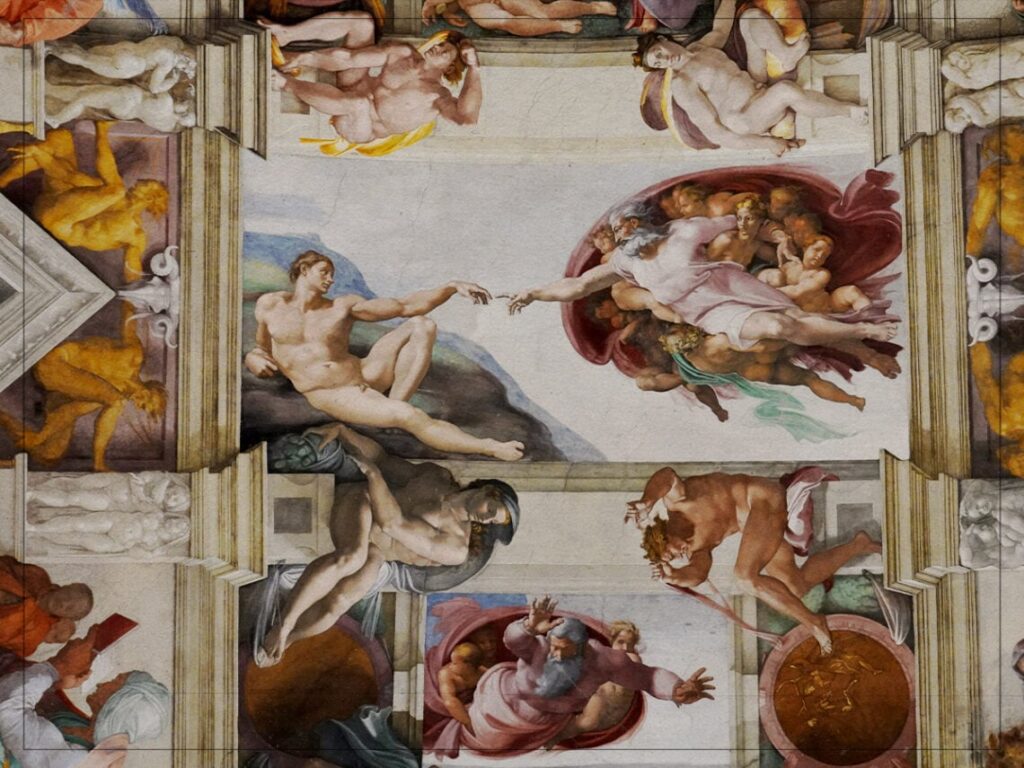
The ceiling recounts the story of the creation of man and his fall from divine grace. Thus, it includes episodes from the creation of Earth and of Adam—the iconic touch-of-God moment—to the expulsion of Adam and Eve from the Garden of Eden. Not only is this painting renowned for its attention to detail and hyperrealism, but also because it was the first time God was portrayed in such a carnal, human way, bringing him closer to the worshippers.
The side walls and middle level contain frescoes illustrating the life of Christ on the right side and the life of Moses on the left side. As stated earlier, these had been completed by earlier Renaissance painters. To complete this phenomenal entourage of ‘Old Masters’, there were also handmade tapestries by Raphael.
Then, around two decades later, the altar wall depicting The Last Judgement was painted, which portrays Christ’s Second Coming and the final judgement on humanity. Real art experts will be able to identify the differences in technique as Michelangelo was much older, in his 60s, at this point, so he was much more experienced.
In an astounding composition of 300 figures set on a celestial blue background, Michelangelo brought to life what the selection process for the afterlife could look like. Christ is in the middle in a tall, muscular and authoritative pose, signalling to the other figures their destiny. These are arranged in three sections: the heavenly realm, judgement, and hell.
While those in the heavenly realm are painted in the same opal colour, with gleaming skin indicating the light shining from within, those in hell are painted in dark ochres and purples, surrounded by skeletons in states of torture. The Sistine Chapel is a prime example of the sheer genius of this ‘Old Master’, whose work remains an everlasting proof of his skill, dedication and craft.
[embedded content]
Related Topics