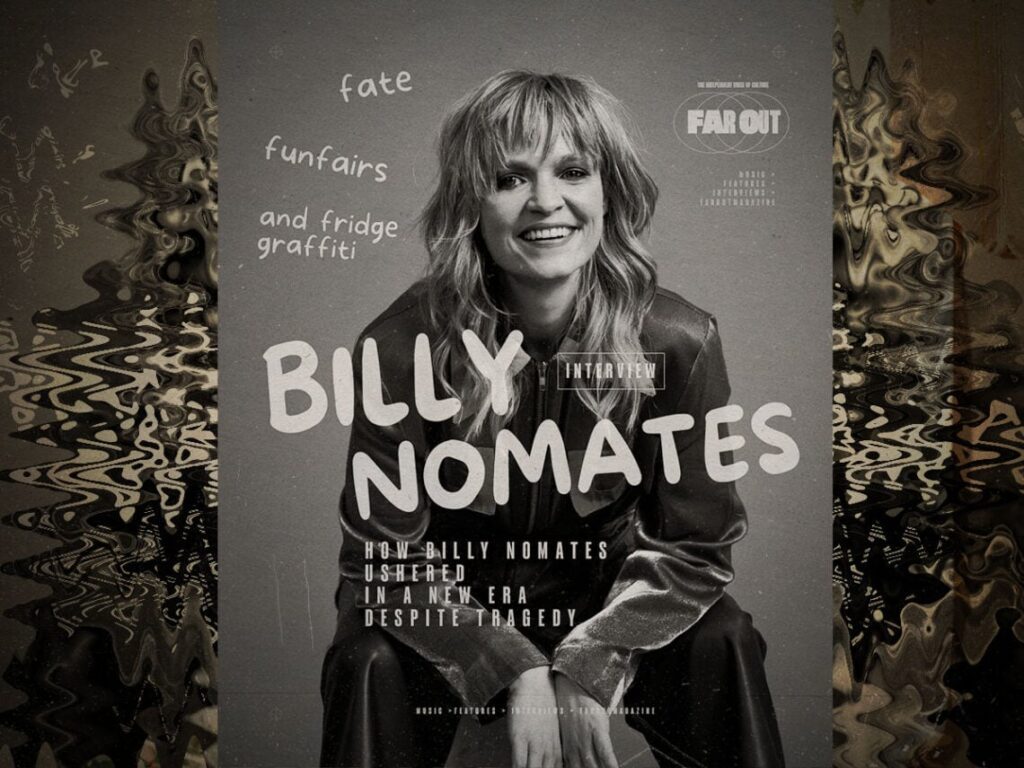
Fate, funfairs and fridge graffiti: How Billy Nomates ushered in a new era despite tragedy
 Posted On
(Credits: Far Out / Billy Nomates)
While Billy Nomates is far from a new project, for Victoria Ann ‘Tor’ Maries, Metalhorse, her third album, is in many ways a reset from where things had been on her earlier records. Made with a band around her for the first time, and written with a goal in sight, the DIY approach of writing until everything feels finished was ditched. This resulted in an album that expands on everything Maries had established before with a transformed sound that lives and breathes as its own entity.
Her second record, 2023’s CACTI, had a nearly similar creation process, but not enough changes to her mode of operation were made to accommodate it at that point in her career. “It was a very DIY album,” she notes of her last release. “I built it quite electronically, so when I did try and put a full band together, it just didn’t work. With Metalhorse, I had the idea of if I’m going to go down that road of that being the live show for this album, then I need to build it that way.”
Bassist Mandy Clarke and Liam Chapman were brought into the Billy Nomates fold around a year and a half ago, and the gradual introduction of their services seemed to be a natural amalgamation to Maries. “They were both coming to shows, and are both based in Glasgow,” she explained, despite their base being far from her Bristol home. It might seem unconventional to pick out to work with a band who live around 300 miles away from you, but the connection she felt was palpable from the beginning. “For about a year, we just sent memes to each other and chatted shit. It was never about music. We were just on the same wavelength. I started demoing it at the end of 2023, and I just thought, why not ask these people?”
Having what she calls “bona fide musicians” on board who have toured with the likes of KT Tunstall, The Go! Team and BMX Bandits, Maries realised that their sensibilities would fit the project perfectly, and after demoing everything over the summer, they booked two weeks at Paco Loco Studios in Seville—a far cry from the environment in which Maries recorded her first two albums.

“I went to Invada Studios [in Bristol] and sketched stuff out whenever it was free, so late at night or on weekends,” she explained of the process last time around. With Clarke and Chapman on board and Paco Loco booked out, things were set to be different, but her intentions didn’t exactly come to fruition in the way she’d anticipated. “Our best-laid plans were that we tried to have it as a group for two weeks, but Mandy had her own tragic loss the day that we arrived at the studio,” she recounted. “We’d planned it for a year, and she had to go home immediately”.
“In the end, even though the intention was that it would be this group bonding thing, it actually never happened that way, and I ended up jigsawing it together like I had done the other albums, which I was luckily used to doing.” With a two-week window in which everything had to be committed to record, Maries found herself working under greater restrictions than before, but having already had a loose guide in place for everyone to follow, threads thankfully found structure. “That was great as opposed to just writing until you drop,” she says of the new process, something that, despite being restrictive, gave her a greater sense of purpose and drive to finish.
This sense of drive is something Maries shared with producer James Trevascus, someone she had already established a solid working relationship with during the making of CACTI two years prior. “He’s quite a light touch,” she said, praising his methods. “He understands that I don’t claim or try and be a virtuoso musician. I’m very self-taught in that respect, so he knows it’s important that things don’t have to be perfect,” adding that “an element of the demo is always in the final record.”
However, Trevascus was the one often commandeering the rest of the group to get the job done and over the finish line while out in Seville, with the holiday destination sometimes leading the rest of the band astray. “He’s really driven, and I needed that, especially when we were out in Spain,” she recalled their fortnight working on the album. “I was sort of like, ‘guys, we’ll start at midday, we’ll go to the beach, and then we’ll do this’, and James would be like, ‘we are going at 9:00 and I will walk you there’. There’s no siestas on his watch.”
Not only did Maries have to adapt her process on record to having other contributors and collaborators, but both Clarke and Chapman have become key parts of the transformed Billy Nomates live show, something that until recently had always been Maries performing solo with a backing track. Having completed a slightly subdued tour with her band for the first time last year, something she claims she “tried to make no bones about”, they’ll return to the road in the UK and Europe in this incarnation in support of Metalhorse, something that is exciting for the artist.
That being said, she’s keen not to lose sight of the project’s origins as a one-woman effort. “I’ll be doing solo shows in between as well, so I’m going to run two separate shows which will both have a different energy about them,” she explains. “Billy Nomates, in its essence, has come from me, and I don’t want to close the book on that entirely. I think all this is hopefully just an enhancement that brings a new energy to it. It’s also just fun for me to have my mates on the road with me.”

This return to playing in a band is something that has been a long time in the making for her as well, with Maries claiming that it’s probably been around 15 years since she last performed with other musicians. Having moved to Bristol for the first time from the East Midlands when she was 18, her earliest memories of gigging in the city were playing mandolin and fiddle in a folk band. “Everyone parted ways and got real jobs and relationships, and I just disappeared into a marketing job for a while, and fell out of love with music because it’s just so difficult,” she confessed about why things dissolved during this period. “I always felt like I couldn’t pierce through whatever I had to pierce through.”
The eventual breakthrough with her self-titled debut album came at an unusual time, not just in her life, but with a major historical disruption. “To this day, I credit Covid-19 for giving me as much radio play as I got,” Maries laughs. “When people ask me how I came through, I have to tell them that a weird, global event happened. I don’t know what else to say, because until then, nothing had happened for me.”
Conceptually, Metalhorse has been floating around in the songwriter’s mind for at least two years. “I have a habit of writing stuff in marker pen on my fridge,” she says, vaguely gesturing towards a kitchen appliance behind her. While the word didn’t necessarily have meaning attached to it initially, she began to discover depths that contorted into some sense of cohesion. “I am a metal horse in the Chinese calendar,” Maries explains, “so it’s my element and it’s my animal.”
The concepts run deeper than the zodiac connections, though. “The more I looked at it every day, I just started writing a whole narrative around it, so it became the name of this old fair that’s falling down, and I took it from there,” she recounts. “It happened the same with CACTI, that was just a bit of fridge graffiti that also came to fruition.”
The funfair theme is an intriguing one, considering that Maries admittedly finds their very nature “horrendous”. She continued to explain her vision, stating, “The last year of my life was very much like that, where it’s this fun place, but it’s falling apart. Some of the rides aren’t quite safe, some people have thrown up, some people are crying, and some people are having a great time. It represented how I felt about the industry, and it represents how I felt about a chapter of life where I was riding high some days and then other days it’s like, ‘get me off this thing!’”
The element of her life falling apart was one close to home, and a major influence on not just this record, but her entire musical career. Her father, Pete, had become increasingly ill from Parkinson’s at the start of 2024, and she and her siblings were dividing care duties among themselves; all the while, Metalhorse was a work in progress. “I think I had ‘The Test’ and ‘Nothin‘ Worth Winnin’ at that point,” she remembers, “so he heard those two before he passed in June last year.”
“My dad always preferred the demo version of everything, so in a way, I feel very secure on a soulful level that it’s okay that he didn’t hear it, and he knew what I was doing,” she says of his reaction to the early drafts and concept; although she did recall a moment where gallows humour provided a sense of light relief despite the dark themes.
“‘Nothin‘ Worth Winnin’ was very much written in the depths of when he got ill and knowing that he was going to die. It opens with: ‘My best friend’s dying and there’s nothing to do’, and I remember showing it to him and him laughing, because with me and my dad there’s no pretence about anything. It was always a case of saying what you mean and being direct.”

Pete had not only a profound influence on his daughter’s music but also that of several others in the local community in Leicestershire, where she grew up. Having raised her and her two siblings up as a single parent, living off the wages of a state comprehensive music teacher, she acknowledges that his dedication to his children and teaching was nothing short of inspirational. “In his spare time, he would record all the local bands and make them demo tapes because he lived to see people live out their creative ideas, and he was the biggest cheerleader for any of that”, lovingly adding, “I owe everything to my dad.”
Her father’s influence wasn’t just from him being a musician, but also the styles of music that he introduced and instilled in her from a young age, which are still present in her music today. Recalling listening to a lot of Tom Petty, American singer-songwriters, and going “from James Taylor to John Denver to Wizzard”, there was a huge importance placed upon music in their household. However, one major influence on her sound was The Stranglers, which would end up being extremely significant later in the process of making Metalhorse.
“The Stranglers were on constantly,” she laughs, before catching herself to make her point. “I’m not joking. That greatest hits CD got absolutely rashed everywhere, in cars and at home.” While the Guildford punk outfit has always been a constant thread in her musical output, Maries was inevitably in shock when, out of the blue, a twist of fate led to frontman Hugh Cornwell appearing on the record.
As Maries gushingly recalls, while recording in Seville, she was speaking to Trevascus about adding elements to the track, ‘Dark Horse Friend’. “I said I wanted to pull up one of Hugh’s vocals as a reference for how I wanted the choruses to sound. As I was saying that to James, Paco, who ran the studio, was just like, ‘well, he’s here tomorrow, just ask him’. Because Paco is Spanish, we were thinking maybe there had been something lost in translation, but lo and behold, he was there the next day!”
”Suddenly, I’m talking to him down the cans, and explaining how I want things to go to him. It was so unexpected. This studio is in the middle of nowhere. It was fate, it has to be,” she happily adds.
In essence, this moment was perhaps the point at which Metalhorse truly became a tribute to Maries’ father, and while she claimed she didn’t want to freak Cornwell out by telling him how much his appearance meant to the record, she knows that it’s the finishing touch that helped everything make sense. There will never be another moment like this in Maries’ career, but there will also not be another album as significant to her as both a daughter and an artist as Metalhorse. Where she goes next on this bizarre carousel we call life isn’t certain, although she knows one place she can begin searching for inspiration.
“There’s another name on the fridge already,” she concludes with a glint in her eyes, “so let’s see what happens to that one.”
[embedded content]
Related Topics