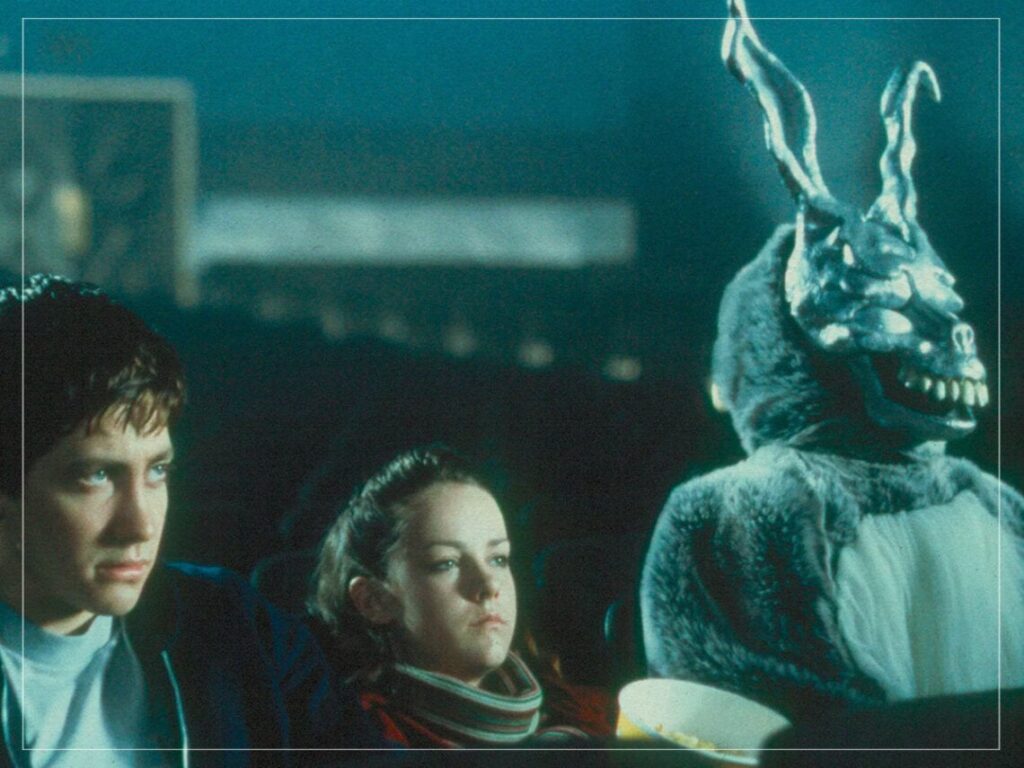
Donnie Darko’s director’s cut: “The whole spectrum of human emotion”
 Posted On
(Credits: Far Out / Newmarket Films)
It’s Halloween, and you load up Donnie Darko to get into the spooky mood.
You close the blinds, light the candles and get the blankets; the New Line Cinema card fades, distant thunder crackles, and Michael Andrews’ haunting earworm of a score tickles your brain as you wait for those delicious twanging chords of Echo & The Bunnymen’s ‘The Killing Moon’. Donnie turns and smiles…and wait…are those synthesisers? A tambourine? Something’s wrong, you tell your partner with a grave look. Have you gone completely mad? Could you have possibly just imagined that your favourite song in the soundtrack is right at the beginning of the film?
While ‘Never Tear Us Apart’ by INXS fits, something just feels cold off; you doubt since it’s been so long since you last watched the movie, you couldn’t even say when, maybe you’ve just merged the opening scene and the song in your mind after all. Halfway through, though, you grow impatient and Google this phenomenon and learn it has a name, appearing in parentheses: (Director’s Cut).
Well, no wonder the film made so much sense to me this time around, where it hadn’t before. I was adamant in telling my partner, who was watching the movie for the first time, to be patient and aware that this film was going to make little to no sense. But the point was the soundtrack, the bodily nostalgia of the grainy blues, greys, purples and greens, the cynical but emotionally delicate attitude, the funny quips.
The crystallisation of the pain of puberty, the parody of the ineffectual, the veneer of adulthood, the sheer empathy for all of the freaks, weirdos and melancholics, all that was the point. But with the director’s cut, the point was also that this is definitely a sci-fi film, where Donnie Darko actually is a superhero with powers of foresight and telekinesis.
A re-release of the film in 2004, this cut not only includes soundtrack changes and deleted scenes, but is interspersed with superimposed images of the in-universe book The Philosophy of Time Travel. These small excerpts help to explain the slightly wonky science behind the time travel in the film, which in turn sheds light on all of Donnie’s ‘hallucinations’ and anti-social behaviour.
By the end of this cut, I fully understood that a Tangent Universe had been created by the rogue aeroplane engine and Donnie Darko was always destined to sacrifice himself, or the entire world would collapse. While I appreciated this deeper understanding, which I’d once read the entire science behind as a teenager, I also felt that my partner was losing something on his first re-watch.
It was all there, served to him on a platter straight away. He didn’t have to go through the head-melding, growing pains of trying to figure out what the fuck just happened. Well, maybe that was also aided by the fact that both our frontal lobes are probably fully developed by this point. I certainly had a deeper understanding of the emotional and mental complexity of the film that I didn’t have as a teenager, whose loneliness simply felt sated by the angry, misunderstood and dreamily vulnerable characters who said ‘cool’, philosophical things and kissed and saved the world.

Or even more than 22-year-old me, who simply had everything figured out and couldn’t understand why the filmmakers had to be so pretentious and not simply have a good plot. However, the question becomes how much of that was emotional growth, and how much the simple, hand-holding exposition that the director thought necessary to include in his cut.
Plus, there was the niggling feeling that something major had been lost in the flair of the film with that one simple song change at the beginning. According to director Richard Kelly, he always intended for the film to open with ‘Never Tear Us Apart’ by Inxs, meant to hint at the family’s ability to stay strong through hardship, that the world would never tear them apart.
By the time of the re-release in 2003, money was no longer an issue as it had been, so they could license the appropriate song and move ‘The Killing Moon’ to its rightful place at the end of the party scene. Of course, it was always meant to be there as yet another layer of exposition, so that the viewers would definitely know that this was the night of the killing.
While the director’s initial line-up for the soundtrack makes sense thematically, and you can see where ‘Never Tear Us Apart’ fits into the opening scene, it once again raises the concern that plagues most detractors (read: most people) of Kelly’s director’s cut: that it simply gives away too much.
I personally feel like foreshadowing is a much more effective intro to this film. There’s a lightness of tone and a hopefulness that the slow synths of the Inxs song bring to the beginning of the film, but this also feels discordant. Yes, the movie can be read as hopeful in the sense that Donnie puts his own selfish teenage needs to have it all aside, and forfeits himself for other people, but at the same time, this always means that he has to die.
‘The Killing Moon’ of the theatrical cut hints that there’s something darker at play here, foreshadowing the violent end, fitting perfectly with the action. The drums kicking in as Donnie peddles faster on his bike and fading smoothly again as he glides around the corner: it just works and sets the whole tone for the film.
The whole film is a puzzle just waiting to be put together the correct way so that they can know exactly what happened, except you can’t, because that’s not the point of art, especially this kind. The whole point is to make you think. Use those beautiful brains of yours, figure out what it means to you, and for those of you who can’t be bothered, you’ll always have the director’s cut. But remember, the director doesn’t always necessarily know what’s going on either.
During one scene of the film, Kitty Farmer, Donnie’s uptight gym teacher, obsessed with self-help guru (and secret paedophile) Patrick Swayze‘s Jim Cunningham, gives his class scenarios and asks them to place them on the spectrum of love to hate. I think Donnie’s response here sums up my feelings towards the director’s cut: “There are other things that need to be taken into account here, like the whole spectrum of human emotion”.
This cut tries to spoon-feed us the film’s meaning and how we should feel, when there’s a whole spectrum of human emotion to consider, and this film already has it all: love/fear, joy/sorrow, excitement/dread. But it also explores all the perceived binaries of our world, trying to smash through them. So maybe I should follow in its footsteps and realise that the perceived binary of director’s cut/theatrical isn’t actually what’s important, but it’s what you take away from it all.
[embedded content]
Related Topics