‘Being Boiled’: The Human League song that kickstarted the synth revolution
 Posted On
(Credits: Far Out / Sheffield Music Archive)
For most, the insurrectionary impact punk had on music was the electric rejuvenation of a pop climate long ossified by lofty prog theatrics and overly earnest singer-songwriters, despite glam’s best efforts to chuck some glitter fun on the early 1970s charts. However, despite embracing the new era of independent labels and DIY ethos, the very presence of a guitar and conventional band set-up just wasn’t revolutionary enough—too close to the old stultified rockist guard a generation of budding futurists saw as desperately old hat.
Alongside punk’s demolition of social and class barriers on the path to pop, synthesizers entered an age of portability and accessibility. Gone were the days when only Rick Wakeman or Keith Emerson could afford to lug gargantuan modular Moogs on stage as part of their grand live spectacle. By the end of the decade, the first synthesizer became available for under $1,000—the humble Korg 700S—ushering in a new wave of Japanese efforts that flooded the synth market, including the patchable MS-20 and Yamaha’s CS-80.
Finally, a working-class bloke from Sheffield with a computer operating day job could, with some savvy budgeting, acquire the mysterious instrument behind Donna Summer’s ‘I Feel Love’ and Kraftwerk‘s electronic constructions assembled in Düsseldorf. Long before Heaven 17’s pop stardom, Martin Ware was one such eager synthesist ready to wield this strange new hardware. “I had a spare bit of money for the first time in my life and it was either learn to drive or buy a synthesizer because they were just cheap enough to buy at that point,” he told Red Bull Music Academy in 2013. “So I went to the local guitar store that had just got the first entry-level synthesizer in there. They were all rock dudes, they didn’t know anything about synthesizers.”
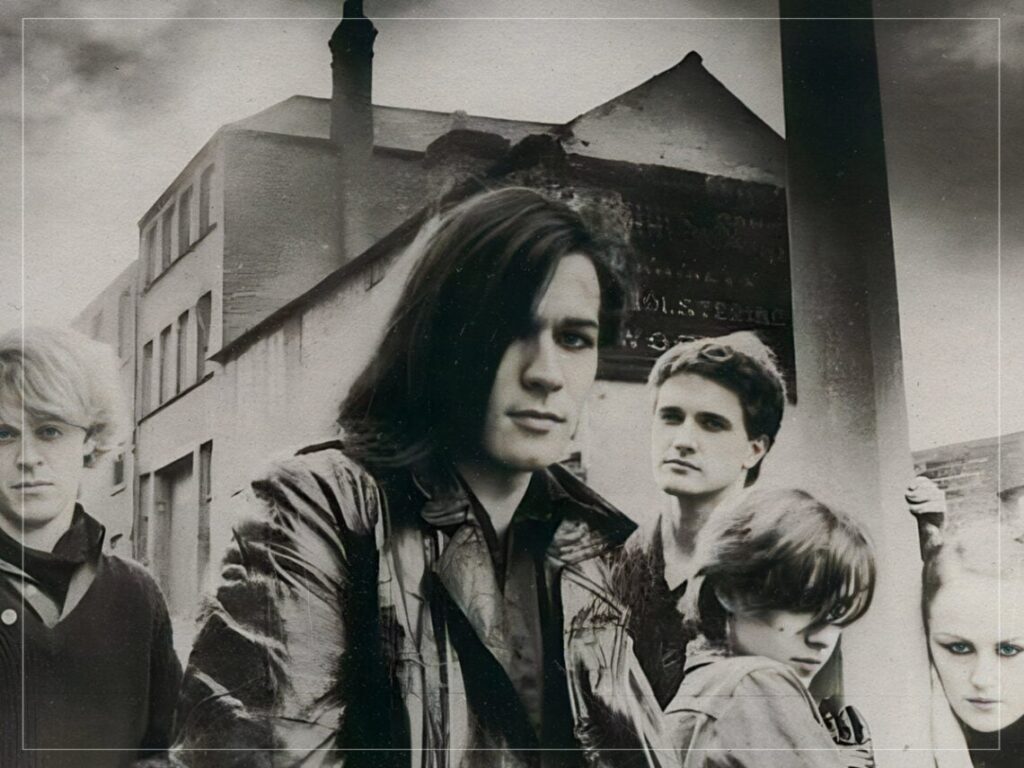
Along with former Musical Vomit frontman Ian Craig Marsh’s Roland System 100, the pair first began experimenting with primitive, lo-fi tape pieces with Clock DVA’s Adi Newton as The Future, leaning into the avant-garde end of the burgeoning electronic happenings conjured by Cabaret Voltaire and London’s Throbbing Gristle at the same time. Recruiting old school friend Philip Oakey, as much for his distinctive aesthetic flair as his unique vocals, and bringing live visuals director Adrian Wright, plus adopting The Human League as their new moniker, the proto-synthpop four-piece looked to cut their first single.
Carting their minimal set-up to a dank, disused cutlery factory, The Human League took DIY to its nth degree. Soundproofing the grimy walls with old fruit trays borrowed from the local greengrocers, the ‘session’ consisted of only their two synths, a reel-to-reel recorder, and one mic, reportedly on a £3 budget. Needing lyrics, Oakey arrived following two days of lyrical scribbling, penning a piece exploring the Chinese practice of boiling silkworm cocoons for the silk industry and its clash with Buddhist respect for nature’s living creatures.
Unorthodox recording and subject matter produced an expectedly confounding result, David Bowie declaring it “the future of music” while John Lydon derided The Human League as “trendy hippies” to NME. Issued on Edinburgh’s Fast Product in June 1978, ‘Being Boiled’ took punk to infinitely weirder and provocative places, saturated with snarling tape hiss, fizzing snaps of metallic snares, and a thick skulking bass groove omitted from the 700S, their debut single palpitated with alien life, taking Kraftwerk’s austere pop arrangements but with a warped sense of P-Funk’s acid-fried R&B in its guts. Dropping to little fanfare, it took BBC Radio 1 DJ John Peel’s routine spin several times a week for it to lift off, selling a respectable 3,000 as opposed to the 20-odd expected from friends and family.
Synthpop was in the air, despite a lack of a coherent ‘scene’. Daniel Miller’s ‘Warm Leatherette’ under his The Normal moniker had yet to be released, Orchestral Manoeuvres in the Dark was still nearly a year away with ‘Electricity’ for Factory Records, John Foxx’s Ultravox was planted firmly in their neon glam, and Tubeway Army was still primarily a punk band. All formed a weird, electronic consciousness that buzzed in the air in punk’s aftermath and the decade’s close of disaffected malaise, feverishly creating the sonic frontiers that would explode early on in the 1980s.
Kraftwerk’s ‘The Model’ had been issued two months earlier on 1978’s The Man Machine, released as a single in Germany that September and later in 1981 for the UK, and New York’s Suicide had set the stage for the synthpop duo years before their landmark eponymous debut, but The Human League’s ‘Being Boiled’ broke the electronic dam that dominated the early British pop scene and helped precipitate the ‘Second British Invasion’ that would conquer MTV, truly kickstarting the synth revolution and the broader new wave Ware and the gang would later ride to enormous success as Heaven 17 and The Human League’s kitchen sink disco mark II.
‘Being Boiled’ would be revisited on later releases, giving a brighter make-over on the Holiday ’80 EP and a beefier production on 1980’s Travelogue, in addition to enjoying live features during their encores to this day. However, it’s the 1978 original that still possesses the deepest power, an ephemeral and urgent document of intrepid pop and sonic vanguard unwittingly unleashing an analogue, monophonic precedent all future synthpoppers owe a debt to.
[embedded content]
Related Topics