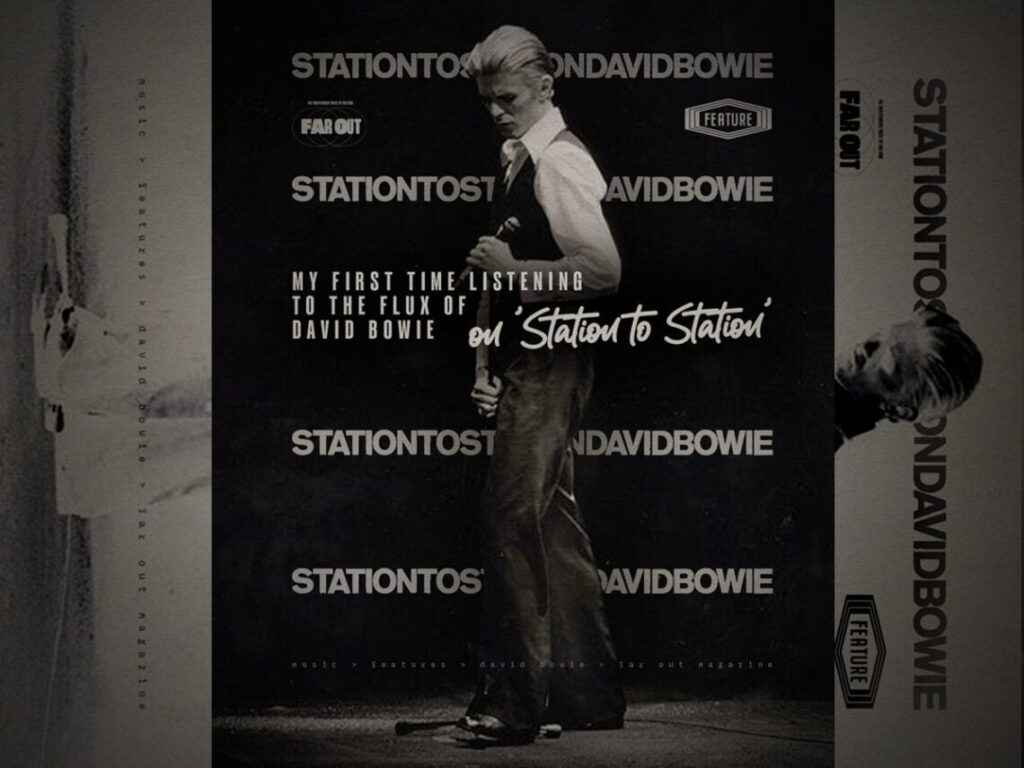
My first time listening to the flux of David Bowie on ‘Station to Station’
 Posted On
(Credits: Far Out / Jean-Luc Ourlin)
When David Bowie died a decade ago, I was simply too blinded by naivety and childhood to fully understand the gravitas of what the world had lost.
I was 13 years old, and while I thankfully had enough of a musical education to obviously know who Bowie was, all of a sudden, I was watching my parents and relatives grieving as if we had literally lost a family member. It bewildered me, to be quite honest. How can you be so moved by the death of someone you didn’t know, and a person as detached as a celebrity at that?
And yet they persisted: stories of letting out guttural screams as the news broke over the radio, making phone calls to console each other as they cried. While I didn’t quite appreciate the magnitude at first, as this period of mourning wore on, the more I began to learn and realise the significance of this man whom I had so far considered merely a distant star.
In effect, this signalled the firing of the gun in my worship of Bowie, a spectral and almost religious understanding which has steadily grown over the past ten years, built now to the point where I love delving into the background of his records, the time periods that shaped him, and the meaning of all his records.
But one that I had inadvertently never managed to get around to until this point is Station to Station, the short but seminal 1976 album that saw Bowie battling with his drug addictions, grappling with fame, and moving from pillar to post within his life. To my mind, at the very least, it has always seemed a more understated record than a Ziggy Stardust or an Aladdin Sane.

The one immediately striking thing in all of it is that, despite Bowie’s enduring genius, is that he seems immediately disconnected. To be clear, that is not meant as an insult of vanity or vapidity, but instead, it embodies something quite ephemeral in the shuttle train the singer was finding himself in the midst of at the time.
That makes a lot of sense in the context of the fact that many cite Station to Station as the defining transition point that sliced Bowie’s plastic soul period and his iconic ensuing Berlin Trilogy that would follow over the course of the years to come. In essence, it’s not as flashy or gregarious by nature, mainly because it was never meant to be.
Nevertheless, my previous perceptions of the record have somewhat surprised me, compared to what it actually contains. Of course, all the roots of the muse for post-punk filter through in their own due time, but what surprised me the most is the high degree of theatricality which unspools at the heart of the album.
That might seem a pretty surface-level analogy given all that Bowie had become known for up to that point, but the recurring romps throughout the six tracks, particularly in the likes of ‘Station to Station’ and ‘TVC15’, have a certain vaudeville air that you just can’t shake; that notion of performativity is palpable, but only because that was the very thing he was trained for.

The particular pertinence of this became all the more obvious as he came off the back of shooting the movie The Man Who Fell to Earth, and that process directly inspired much of what Station to Station became. Take the closing song, ‘Wild Is the Wind’, as the clearest example, not even a Bowie original, having been originally sung by Johnny Mathis in 1957 for the film of the same name, but every bit as fitting in the context of the Starman’s state of flux.
There are, of course, the less whimsical efforts in the form of ‘Golden Years’ and ‘Stay’, staples of that funk persuasion he inhabited so suavely, but for me, masterpieces as they might be, those songs do not pierce the true heart of what Station to Station, although they do obviously play a role.
Listening to the album now, for the first time but half a century on from its first release, it’s clear that was a man who didn’t know what the future held. Sure, none of us do, but when you’re a musician, that position of uncertainty comes fraught with added risk. In a moment that spearheaded Bowie’s opening commercial era with his most prolific, it strikes me that Station to Station was the true turning point where he decided to let go of inhibitions.
Much like the spirit of ‘Wild is the Wind’, after the depths of his drug addictions had finally let him go, he was free to travel in any direction he liked. Station to Station may have been the process of painting on a ruse and shuttling back and forth, but everything that came next was the mark of pure freedom, and hearing that now, it’s exactly what we all need.
[embedded content]
Related Topics