Why ‘To Pimp A Butterfly’ should have won a Grammy for ‘Best Album’
 Posted On
(Credits: Far Out / YouTube Still)
Contrary to popular belief among my close circle of friends, who view the job title of Music Journalist as a codeword for fun sponge, I do actually like pop music. My intention to work in music wasn’t to shit on bubblegum pop as a means of displaying heightened intelligence because, in the immortal words of Dua Lipa’s T-shirt, “hating pop music doesn’t make you deep”.
It’s true, it really doesn’t. There is an art to writing a good pop song and tapping into the widespread consciousness of music fans, and so I am going to tread carefully when I defend this one sacred album, which was snubbed by the Grammys for a less inspiring, entirely poppy album.
Flicking back through the history books of music, I would be hesitant to label the mid-2010s as a period of time as fruitful as, say, the entire 1970s, or the mid-1990s. In fact, it seemed as though this period of time represented an artistic generation in limbo, fluctuating without intent between the traditionalist ideals that got us here and this brave new future, promised by rapid digitalisation.
Sure, it made for a great era of tech-drenched pop, but it left everything else feeling somewhat confused. Alternative music, in particular, felt like it was bleeding a slow death, and the blood that was pouring out was fluorescent liquid à la MGMT.
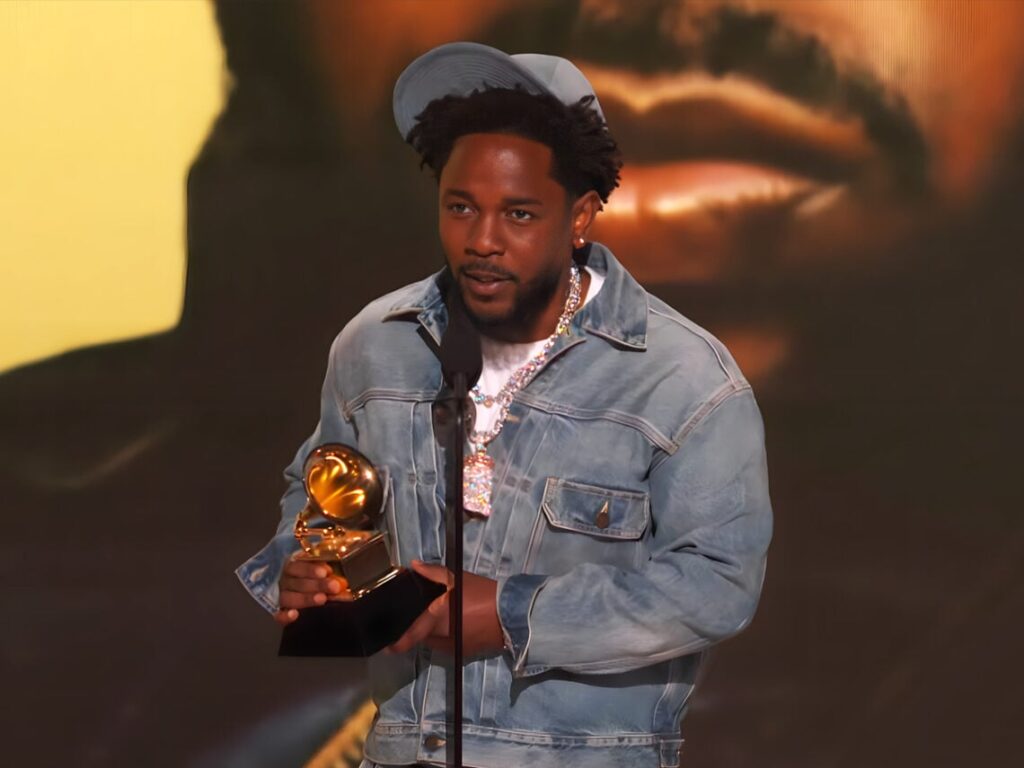
Naturally, music fans felt somewhat apathetic about award shows as a whole. They had wholly become epicentres for commercial backslapping, and very rarely were there genuine albums of merit being highlighted. But then, in 2015, that all changed. No, not in the form of Tame Impala, Courtney Barnett or even the return of Blur. But in Kendrick Lamar’s iconic album, To Pimp A Butterfly.
It was a sheer masterclass in first-person storytelling that cascaded through an endlessly twisting route of instrumentation. It was west coast hip-hop, meeting east coast jazz, hushed rap meeting performance art, it was Amiri Baraka beat poetry meeting the 21st century philanthropy of a young Lamar. Somehow, Lamar managed to thread the overarching concept of a caterpillar overcoming the trappings of money, greed and crime to metamorphose into a socially conscious butterfly, all while allowing each and every song to have its own distinct narrative arc. It wasn’t just the best album of the year, it was the best album of the century to date.
However, that year, it failed to win ‘Best Album’ at the Grammys, despite its obvious supremacy. It lost out that year to the darling of the awards, Taylor Swift. Now, here is where my assault on pop music needs nuance. Because ultimately, my stance doesn’t come from a position of hatred or discontent towards Swift’s music, no, I fully accept the merited role she plays in pop songwriting and how influential she has been, despite my lack of fandom.
But in this instance, she’s come to represent a rather warped systematic viewpoint that exists in the Grammys and more broadly, America. A refusal, if you will, to treat rap, hip-hop and the music of its most urban communities as a genuine art form with the merit to rival songs of all genres in award shows. Lamar winning best Rap Album isn’t enough for To Pimp A Butterfly, because ultimately it’s greatness exceeded the limitations of that genre.
Palettable and inoffensive pop, that on this album mused about the grandeur of living the American dream in New York, was of course going to win over an album that brutally exposes the systematic racism that fuels the corrupt underbelly of the country’s society. Why? Well, ultimately, in a country obsessed with hyper-capitalism, Taylor Swift and more specifically 1989, is the perfect platform upon which they can advertise their country to the world.
I hear you, though, “Callum, it was ten years ago, it’s not that deep.” Maybe it isn’t, maybe it is. But the fact is, the timespan of a decade would have populated merely a line in To Pimp A Butterfly, for the historic references within that album span the length of centuries, and so it goes to prove that there are many more lines left in this story.
[embedded content]
Related Topics