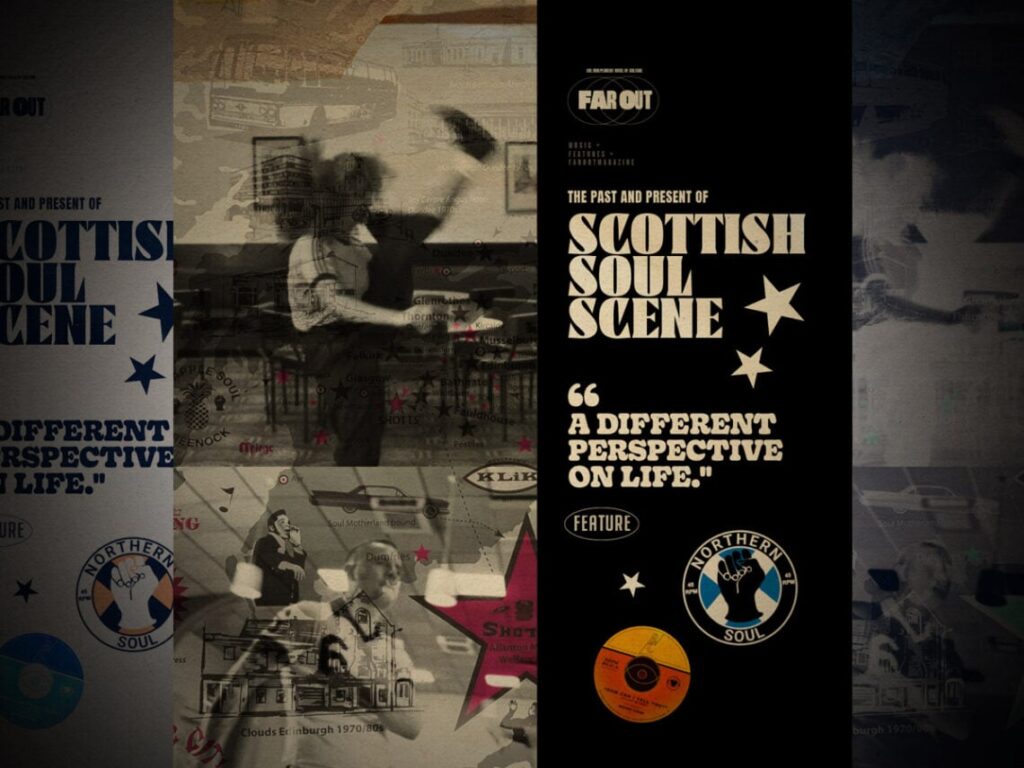
The past and present of the Scottish soul scene: “A different perspective on life”
 Posted On
(Credits: Far Out / YouTube Stills / Mark Wallace)
Northern soul is, as its name most obviously suggests, a musical tradition steeped in one very little corner of the world, but here’s a concept to blow your mind: what if northern soul travelled even further north?
After all, it isn’t as if you cross the border near Carlisle and the whole landscape dissipates, not least the cultural and musical one. While Scotland boasts many of its own distinct artistic traditions compared to the rest of the UK, its soul scene is something that has managed to float up through the airwaves from the north of England and make itself at home within many pockets of the country’s clubs and dance halls, but often without a lot of the rest of the world knowing about it.
Equally, though, it’s not just a simple case of a scene replicated; a copy and paste job that bears no sense of difference to the culture it was inspired by. Like many aspects of the life that takes place within the country’s walls, the lifeblood of Scottish soul is a truly unique mix of time, place, tradition, and politics, which makes its little microcosm a safe haven for those born and bred within it, and an inviting chalice for those looking to be initiated into the not-so-secret, but certainly underrepresented, club.
Yet in the grand old year of 2025, when many other sectors of the live music industry and its communities are struggling to survive, particularly in such a concentrated country, the Scottish soul scene finds itself at an especially diverse crossroads. There are the self-confessed ‘oldies’, vying to keep the landscape of nostalgia alive as they knew it in their youth, while a fresh flurry of new homegrown artists are taking a shot to see if they can embody the spirit of soul in a whole new generation.
It’s definitely not a case of the warring sides of the Montagues and Capulets; at the end of the day, all those involved in the scene, whether recent or classic members, want it to thrive far beyond what is currently on offer. It’s just that the visions to get there come from highly different viewpoints, from different eras of life, and from different perceptions of the soul scene itself.

Naturally, however, like any other scene in the rest of music, you can’t even begin looking forward to the future without first honouring the past foundations on which the principles of the landscape were first built. For this, Paul Massey, running the website Soul Scotland, is the bona fide expert, not only harnessing the classic history of the scene but keeping it alive by posting about every event, development, and piece of nostalgia that takes place.
In his eyes, however, the scene is very delineated under the realms of what it wants to be, and largely has always been. “At the end of the day, it’s people putting on records and people dancing,” he tells me simply, “Down south, there’s more people, there’s more numbers, there’s more people buying records and more audience to play them to. I think the scene in Scotland is a little more steeped in the past rather than looking forward, and that’s fine. If that’s what it wants to be. It’s clear. Most of it does what it says on the tin. If it says there’s an oldies night, it’s an oldies night, and you’re not going to hear anything particularly new.”
Taking the scene back to the roots of when Massey first joined it, having hailed from the West of Scotland but spending 20 years of his life in Aberdeen, however, there was one distinct pattern which emerged. “You gathered, saw, and understood from what was going on that it was pretty much all down the east coast, from Dundee, Aberdeen, Perth, to some extent, and then Edinburgh, and there was less going on in the West.”
“That’s not to say that it [the West] didn’t have a scene, or it still doesn’t have a scene,” he adds, highlighting, “It does have a scene; historically, some of its venues and DJs are remarkable, but just in terms of sheer quantity and continuity, it’s always been the East Coast, the cities and satellite towns round about there, like Bonnyrigg, Bathgate, Penicuik, Musselburgh, and places like that.”
The obvious question is how the northern soul scene came up from England and settled itself primarily in such a distinct space in the country, but the trouble is, no one really knows the answer. “I don’t quite know why it happened,” Massey laughs. For longtime stalwarts like he and his friends, the core axis on which the scene spun for many years was The Spiders’ Web pub on Morrison Street in Edinburgh; on one hand dubbed ‘The Cavern’ by the uninformed for its wall-to-wall plastering of Beatles memorabilia, but for those with the soul-infused hearts, it came to represent something so much more.
“The Web was certainly the sort of beating heart, as it were, of Scottish soul for a while, because it just covered all the pieces and had continuity, good guests, and good local DJs. It just ticked all the boxes.” When the pub shut its doors for the final time a decade ago, many might have thought the scene would struggle to survive, being seemingly rudderless, yet there is a tenacity of spirit which shines from Massey’s view on the landscape as it still steadfastly stands now. “The nights that are still going strong are the ones that have lasted and proved they’ve got the audience and the records,” he claims.
The soul world that Massey presents is one that is pretty insular and certainly steeped in its own tradition, but he is quick to point out his ambitions to get more young people involved in the scene. That’s exactly where someone like Brooke Combe comes into the fray, whose latest single ‘How Can I Tell You?’ has quickly become a fresh beacon of Scottish soul in crowds both old and new.

Having grown up in the town of Dalkeith near Edinburgh, Combe is in the precise heartland of where the Scottish soul scene supposedly has its greatest presence. But she has a very different perspective on this landscape, as she explains, “I’ve always grown up feeling really disconnected in Edinburgh from music itself, because it’s just not the city for music, Glasgow is.”
Regardless, for her, the current rise being witnessed in soul music at large comes as no real surprise. “People forget how much of an influence soul music had on other genres,” she rightfully points out, “Honestly, I feel like people think the country’s just built on indie music and rock music, but all that came from the soul scenes.” Coupled with what she views as a currently “diluted” pop market, audiences, and particularly young ones, are in the mood for seeking out something different.
Like most parts of the world, Scotland struggles with crime, with its unique set of circumstances, often fuelled by sectarianism, violence, and gangs, known more commonly in adolescent circles as young teams, frequently borne out of a lack of stimulation.
“What comes with soul music is that community, the dance community, for example, for young people to be interested in again,” Combe suggests. “Right now, there’s so much knife crime, and it just feels really dark. I feel like a little bit of music is always going to help that. But not only that, having a community where you feel part of something like the northern soul scene will distract your mind, will show you a different perspective on life. It’s not just all about going to the pub.”
In this sense, the perhaps unexpected local virality of ‘How Can I Tell You?’ has come as a welcome surprise to her, but it is also a sign of the times in showcasing this point. “It’s an underground scene,” she admits, “But now that I have seen the reaction from so many, I’ve been tagged in so many young people dancing to it, it’s definitely not just for the oldies. However, I think the exposure to it as kids is a big thing, because that’s what happened to me.”
This early exposure to soul music comes from the obvious places and staples of the canon far beyond the Scottish walls, but it doesn’t mean that the roots of home have been entirely absent from Combe’s inspirations. “A big Scottish soul inspiration for me growing up, obviously, is Paolo Nutini,” she says, “I’ve been yearning for that again. I’ve not felt that feeling that I felt for the first time listening to Paolo Nutini since he came about. So, I hope that I can be that for the people of Scotland as well, and for them to be proud of the music that’s coming out the country that isn’t just indie, or bagpipes, or Gàidhlig dance music.”
On the whole, Scottish soul is far from a completed scene; Combe admits she’d love to have “mates to be able to talk to about this stuff” in terms of fellow artists and songwriters creating new music, but awareness is on the rise among both sides of the community. Massey even separately mentions Combe by name, saying he hopes she “energises” young people and “pushes them in the direction towards northern soul”. Nevertheless, there is still a long way to go.

As the self-confessed older demographic of the scene, Massey says up-and-coming artists need to represent something more than just “pulling on an Adidas t-shirt and a pair of baggy trousers”. Simultaneously, he also believes that some of the longest-standing stalwart fans need to open their horizons a little more to new emerging artists. “Some people in the soul scene turn their noses up and see this is just cashing in, which I don’t think is entirely true all the time, but is viewed with some slight suspicion,” he says.
In the same way, eventually Combe hopes for a “cool community of northern soul dancers and the scooter gangs”, but also, sonically, “to actually have musicians and artists and songwriters that are also doing that, because I’d love to work with other people, and write for other people, or have them write with me. I’d love to see more of that, especially in my home country, because it would make me severely proud”. For now, however, she is quite happy flying the flag: “Oh, I’m just getting started,” she grins.
To some, the northern soul scene in Scotland might look like it crash-landed from outer space. After all, how can you establish a community when nobody has any idea why it is rooted where it is, the depth of its traditions, or why certain sections of the scene are seemingly so against moving it forward? In many ways, this simply reflects a microcosm of Scotland as a whole, where it takes a few rebels to really make a change. It may take a few more people to join the charge, but until then, the oldies and the newbies can agree on one thing: they just have to keep on dancing.
[embedded content]
Related Topics