Anatomy of a Scene: Agnes makes the baby a promise in ‘Sorry, Baby’
 Posted On
(Credits: Far Out / A24)
“I’m sorry that bad things are going to happen to you,” says Eva Victor’s Agnes to her best friend’s infant daughter in the subversive culmination of Sorry, Baby, the best A24 film of the year.
Jane Schoenbrun influenced Victor’s directorial debut (which they also wrote), which is an unconventional treatise on trauma, following Agnes in the years after a “bad thing” happens to her.
In this film, we see Agnes cope with the smallest, silliest of things, instantly falling in love with a stray cat or having a “good sandwich” with a stranger after a panic attack. Victor shares the screen with Naomi Ackie, who plays Agnes’s best friend Lydie, and one of the ways Sorry, Baby illustrates how life goes on is through this character. Lydie is Agnes’s support system, but she is also exploring her sexuality and eventually moves away, meets her partner Fran, and starts planning for a family.
The non-linear story is bookended by ‘The Year with the Baby’, the film starting with Lydie visiting Agnes and telling her she is pregnant, and ending with her visiting again, this time with Fran and baby Jane. One morning, Agnes insists that the couple go to a lighthouse by themselves while she watches the baby, and Fran, clearly a nervous new parent unsure of Agnes’s childcare experience, bids adieu by cautioning, “Don’t drop her”.
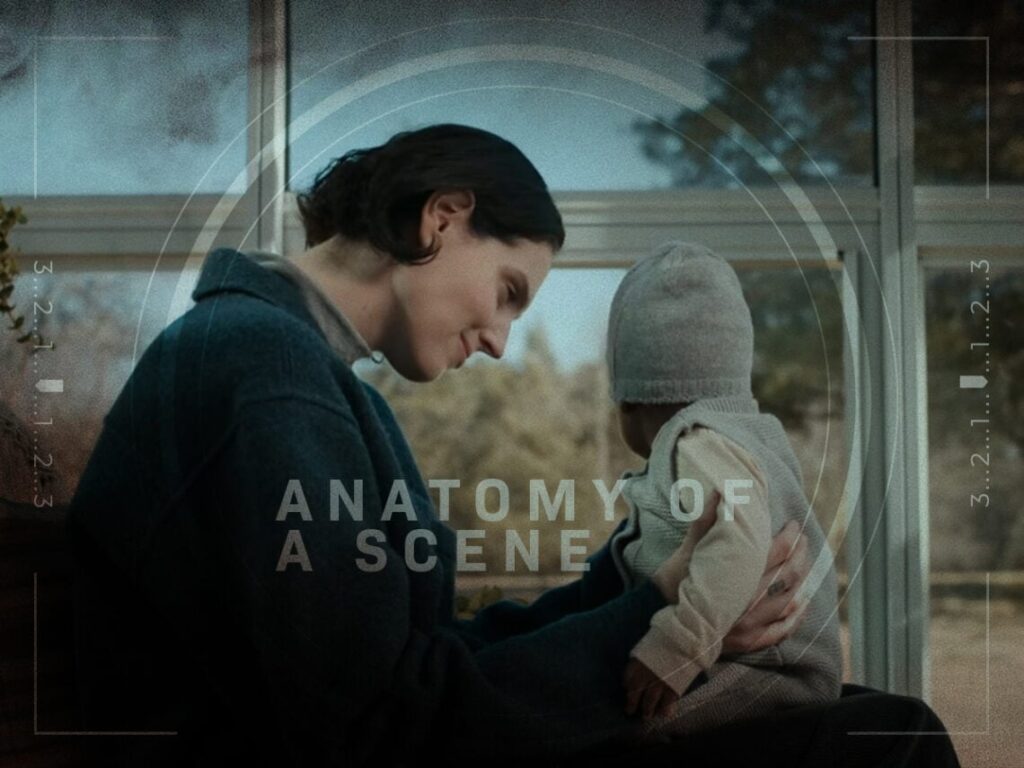
Once the parents leave, Agnes awkwardly approaches the crib, the camera focusing on her as she peers down, before cutting to a shot of Jane. “Hi. I’m Agnes,” she says plainly – as if now they’re alone, she can finally introduce herself properly. She picks up the baby, thinking that’s what she’s meant to do, but when she tries to put her back down, the baby starts crying, so she scoops her up again, and they head out to the porch.
I couldn’t tell you exactly why, maybe it’s the overall demure nature of Sorry, Baby or Victor’s beautifully down-to-earth performance, but something about the way Agnes holds the baby makes the interaction appear far sweeter than anything similar I’ve seen in film.
As Agnes launches into her finale monologue, the camera mostly stays on a close-up of her with the baby’s head clearly in the frame, occasionally switching to Jane’s happy, innocent face, with only the rustling leaves and chirping birds of the New England setting in the background. “When you grow up, you can tell me whatever,” says Agnes, “Like if you have a thought, and you’re like ‘that’s a bad thought’, I probably had that same thought, but like ten times worse. So you can just tell me. I’ll never be scared by that.”
Agnes continues, “If someone does something bad to you. If someone says something scary. If you wanna kill yourself, like with a pencil or a knife or whatever, you can just tell me. I’ll never tell you you’re scaring me.” Albeit a somewhat blunt way to acknowledge that this infant may someday experience suicidal ideation, which it’s probably good she doesn’t understand at this moment, the speech is characteristic of her: straightforward, darkly thoughtful, and gentle.
The bits of repetition in her words are very subtle poetry, and the underlying message is the most honest form of support, like what Lydie lent to her, which outlines that nothing is too big to scare Agnes away, and she can always be counted upon to be there to help. Keeping it as real as she knows how, Agnes also says, pinpointing the sadness of having to grow up at all, “That’s why I feel bad for you, in a way. That you’re alive, and you don’t know that yet”.
“But I can still listen, and not be scared. So that’s good, or that’s something, at least”, and that sentiment is what Sorry, Baby illustrates throughout: that there is no one way to heal, but the simple existence of something or someone is something to reach out is the most important thing to have. The film ends with a clear shot of Agnes and Jane face to face, their differing experiences of the world due to age and budding connection acting as a renewal of Sorry, Baby’s lifeforce.
[embedded content]
Related Topics