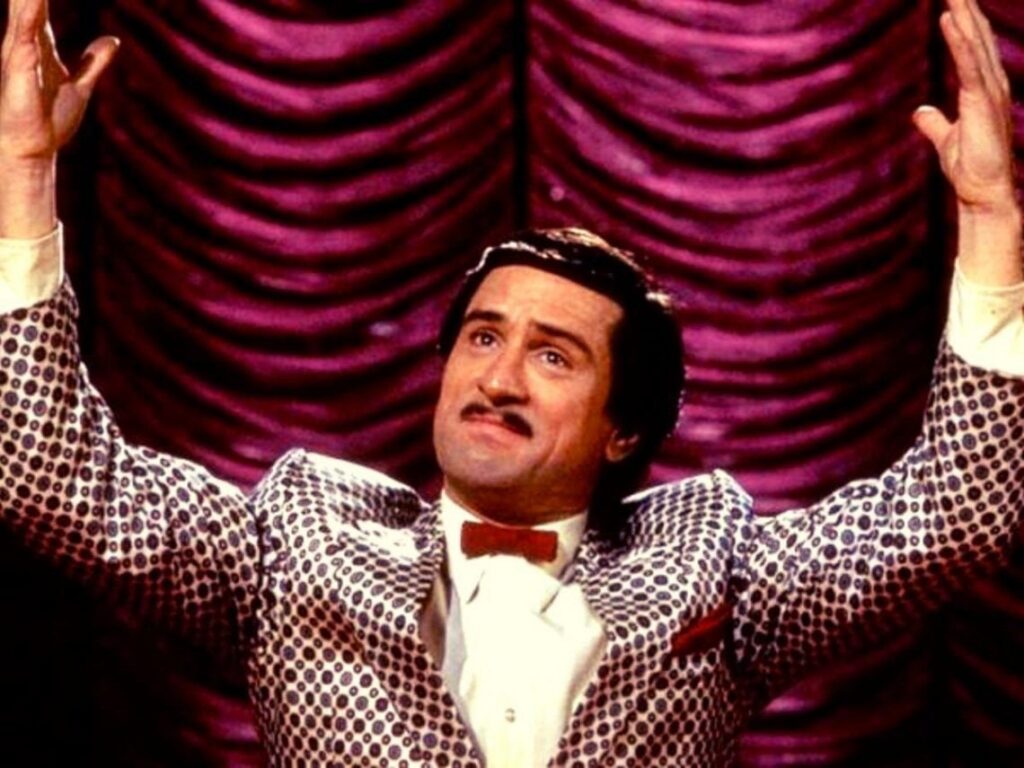
Why Robert De Niro needed to convince Martin Scorsese to make ‘The King of Comedy’
 Posted On
(Credit: Mubi / 20th Century Fox)
In the wake of the commercial collapse of Raging Bull in 1980, Martin Scorsese was at such a low ebb in his career that he began to wonder if he should even be a filmmaker anymore.
Of course, that movie’s fortunes would turn around pretty quickly when it was nominated for a host of Oscars, and in the future, it would be hailed as one of Scorsese’s greatest films. At the time, though, the depressed director thought he was living on borrowed time in Hollywood, especially because his previous film, New York New York, had also been a commercial dud. To make matters worse, in this period, the troubled director was suffering from a substance abuse issue, and believed the business of moviemaking was heading in a negative direction after the vibrant experimentation of the 1970s.
As incredible as it sounds now, given that most critics these days consider Scorsese to be America’s greatest living filmmaker, the Taxi Driver visionary was so disillusioned that he considered retirement. He told Les Cahiers du cinéma that he hadn’t found the “inner peace” he was looking for through making movies, and it made him want to make documentaries instead.
Perhaps there is an alternate universe somewhere in which Scorsese did pack it in after Raging Bull, and those poor saps never got to see banger after fucking banger like After Hours, Goodfellas, The Age of Innocence, Casino, The Departed, and The Wolf of Wall Street. I, for one, wouldn’t want to live in that universe.
Thankfully, a goddamn hero stepped in to rescue Scorsese from himself: Robert De Niro, who had loved working with the director so much on Taxi Driver, New York, New York, and Raging Bull so much that he wanted to team up again. A weak Scorsese half-heartedly suggested that De Niro could play Jesus in his long-gestating The Last Temptation of Christ, but De Niro had already put himself through the emotional wringer for Raging Bull, and preferred the idea of doing something lighter.
To that end, he reminded Scorsese of a script he’d initially brought to him in 1974. It was written by Newsweek journalist Paul Zimmerman, and told the darkly satirical story of a failed comedian obsessed with a successful late-night talk show host. At that time, Scorsese read the script, but didn’t really get it, and had no personal connection to the material, so he passed.
Six years later, though, after Scorsese had experienced the script’s themes of the alienation that comes from the pursuit of fame on a very personal level, he understood it more. De Niro also assured him the movie could be shot quickly, and in New York City, away from the prying eyes of a Hollywood studio. Eventually, De Niro got his way, and Scorsese signed up for a film that turned out not to be light in the slightest. In fact, it was almost as dark as Raging Bull, and any time the two men hear anyone refer to the film as a comedy, they tend to baulk.
Whatever the case, De Niro’s powers of persuasion were strong on this one, and he pulled Scorsese out of a pretty significant funk with The King of Comedy. However, according to De Niro himself, the process was really as simple as how he described it to The New York Times Magazine in 2012. “I wanted to do it, Marty was reluctant,” he concluded, “but we just did it, and that sometimes happens in things that I’ve done with him. I did it just to work together.”
[embedded content]
Related Topics