‘Bunnies’: How art is beginning to talk about AI
 Posted On
(Credits: Far Out / Oliver Richman / Cash Macanaya)
As you will be all too aware from a passing glance at any corner of the internet over the past year, artificial intelligence is becoming an increasingly unavoidable presence in the digital landscape, whether we like it or not.
During the early days of AI technology, the presentation of its power was rooted in taking over menial tasks, freeing time for ordinary people to get on with more important things. As it turns out, AI also has a much darker side. From inducing psychosis in the younger generation to spreading political misinformation on social media, and, most recently, directly influencing a teenager to take his own life, the prevalence of AI is becoming much more frightening as it infiltrates virtually all forms of life on the internet and beyond.
One such avenue where AI has made unexpected and incredibly worrying advancements is that of music and art. Generative AI is trained on pre-existing information, and the music, writing, artwork, and photography of countless creatives have been unjustly plagiarised in order to make these AI models far more believable, masquerading as genuine songs, videos, and photographs. Not only has this practice led to millions of artists having their work ripped off, with no way to fight back, but it has also fueled the fire of misinformation online, spanning the spectrum of danger.
This has exposed us to AI-generated videos of politicians making fraudulent and inflammatory statements, to one widely shared social media clip of rabbits jumping on a trampoline, which, in particular, has become an indicator of the technology’s scary believability and wildfire reach across the internet. “Seeing is believing”, but that old adage presents a conundrum where what you are seeing might just be ripped-off artifice.
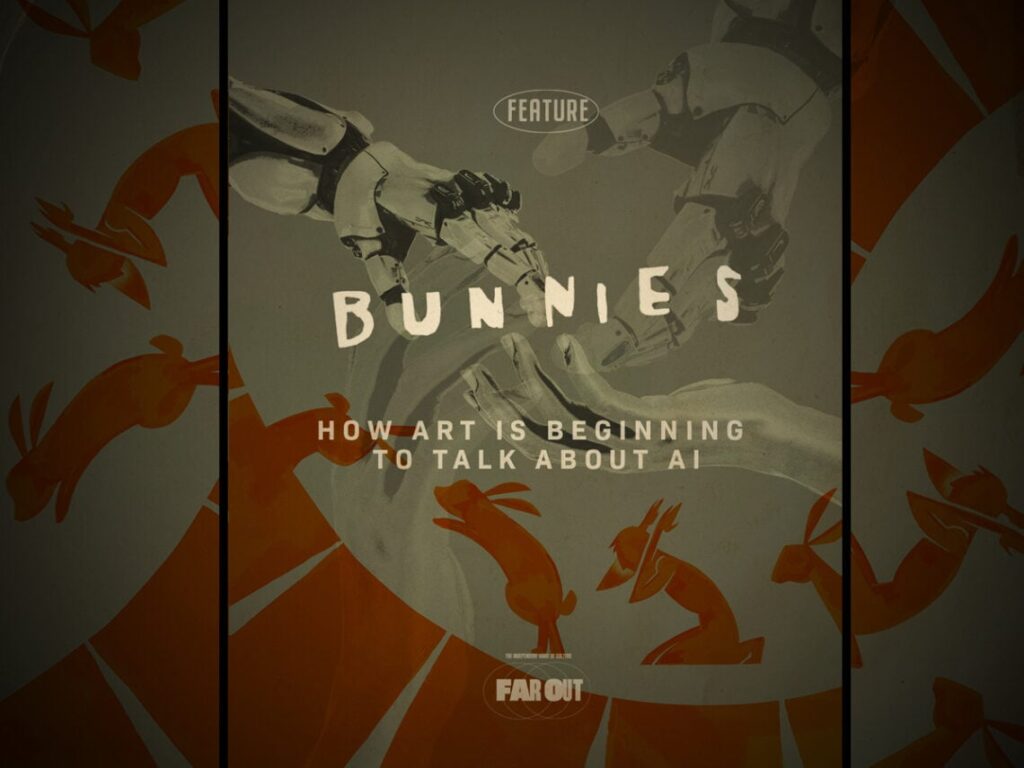
Now, creators on social media are using the inspiration of that AI rabbit video to discuss their own fears over the rise of AI through the lens of the song ‘Bunnies’. Penned by Californian actor and musician Oliver Richman, grandson of the legendary songwriter Ron Miller, ‘Bunnies’ uses that generated clip to explore the extensive reach of AI on the internet, and all the existential dread due to its skewed offering of a reality.

While the song, as delivered by Richman, is in a musical theatre performance style (as though it has been taken from a particularly depressing musical focused on AI-induced psychosis), it is not likely to win any awards for songwriting; nevertheless, it does open up a vital discussion about AI’s influence on music and art.
We have already seen countless artists, young and old, bemoan the effects of AI on music, whether that’s claiming that it cannot capture the human emotions at the heart of songwriting or denouncing the rise of entirely AI-generated bands on platforms like Spotify. However, there have not yet been many instances of musicians targeting AI directly, within their songwriting. Whereas Richman’s track is aimed at the rise of AI and the fear surrounding, it has also given multiple other performers and creatives a discourse foundation to which to add their own two cents.
Ultimately, ‘Bunnies’ is not going to single-handedly dismantle the irreversible rise of AI, but the conversation that has circulated with the song as its centre point is essential in spreading awareness of the dangers of generative content on a platform like TikTok, where no amount of community notes can dispel their tumorous growth.
After all, the number of people welcoming AI into their daily lives is on the rise, with companies behind the product marketing it as the next great technological leap, in spite of mounting evidence that AI is destroying creativity, critical thinking, and healthy brain development for the younger generation.
‘Bunnies’ won’t be the last song to attack the rise of AI, and keeping the damaging nature of the technology, both psychologically and environmentally, in mind is vitally important in protecting our creative industries from slipping firmly into its clutches.
[embedded content]
Related Topics