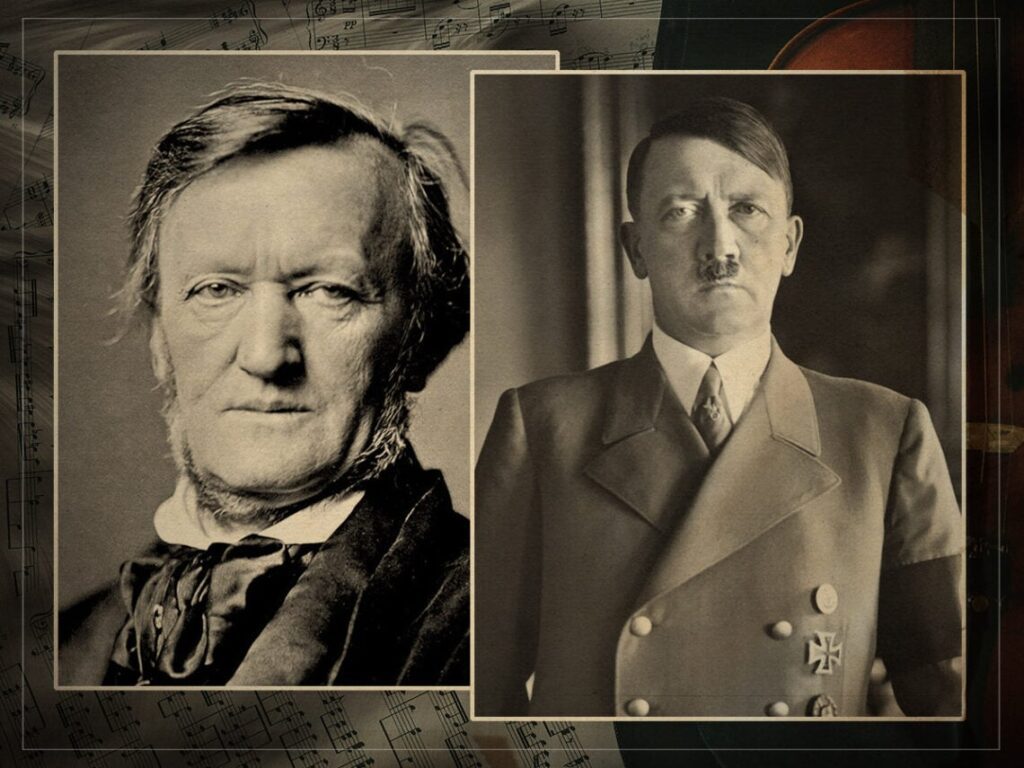
Did the music of Richard Wagner somehow help shape Adolf Hitler’s ideology?
 Posted On
(Credits: Far Out / Franz Hanfstaengl / Heinrich Hoffmann / Public Domain)
People love to talk about how the greatest rock stars of the 20th and 21st century have all been complete loose cannons, regularly living up to the supposed rock and roll lifestyle and engaging in all sorts of debauched activities.
We cover stories of this on a regular basis, but have you ever considered that they weren’t the first to do, say and align with controversial things, and that the classical composers from centuries past were equally as crazed and unpredictable?
For example, Wolfgang Amadeus Mozart had something of a penchant for toilet humour, writing various pieces that referred to anilingus and testicles as a form of childish amusement. On the other hand, Erik Satie had a very restrictive diet that meant he would only eat white foods, and had two pianos in his home stacked on top of each other. There are plenty of other bonkers composers I could name, but in reality, there are none more unhinged than Richard Wagner.
Yes, he may have revolutionised music in the Romantic period, and was hugely influential in the development of modern classical music with his slight avant-garde and experimental tendencies, but at the same time, he was unfortunately a great influence on one of the worst events in modern history.
Being the raging anti-Semite that he was, and a prolific commentator on his prejudices towards non-Aryan and non-German people, he became something of a symbol for German nationalism, and would eventually have a massive influence on Adolf Hitler and the rise of Nazism in the early 20th century. While Wagner was already dead before the dictator was born, because he was so highly regarded in an artistic sense in his home country, with his operas still being performed in theatres, Hitler would have had plenty of exposure to his work, and regretfully, his points of view.
Once Hitler had appointed himself as Führer and the Nazi Party were in complete control of Germany, the party would regularly play the music of Wagner at rallies, because it was seen as symbolic of German patriotism, promoted Aryan values, and used Jewish stereotypes for characters in his works. Not only that, but his writings were outwardly anti-Semitic and racist, with one of his most famous essays being titled Das Judenthum in der Musik (lit. Jewishness in Music), which was critical of the Jewish influence and ‘infiltration’ of European art and music.
However, there are a number of things that have been claimed as fact over the years, which have debatable evidence to back them up. Assertions that Wagner’s music was played in the Dachau concentration camp as a means of educating political prisoners on German values, but there is little evidence that it was played at Nazi death camps, as some historians have claimed.
There’s also dispute over how popular he was in Germany at the end of the 1930s, and there is perhaps more evidence of Italian composers having their works performed in the country. It may well have been the case that Hitler was shaped by some of Wagner’s teachings, and saw him as culturally acceptable in his ideal vision of Germany, but it wasn’t necessarily something that was reflected in society, where the range of interests stretched far beyond.
In addition, Hitler would have developed his ideologies from various different places, and likely wouldn’t have just read the essays of Wagner and appreciated only his music. His involvement in the Munich Putsch in 1923, which saw him imprisoned, was a sign that this burning hatred of Jews and those who were of no value to German society in his eyes had been lingering for some time.
Having enjoyed his work since adolescence and spent his pocket money on watching recitals, there is clearly a reasonable degree of influence, but it’s hard to say that Wagner is single-handedly responsible for the rise of Hitler and Nazism. His association with unsavoury points of view is palpable, but the fact remains that Hitler’s deep-seated anti-Semitism came from a far broader range of places, and from his own personal experiences.
[embedded content]
Related Topics