Keep The Faith: Why was Wigan Casino allowed to close?
 Posted On
(Credits: Far Out / Wigan Casino / Original Promo)
“Long after tonight is all over, long after tonight is all gone, I’ll be yours for ever and a day.” – Jimmy Radcliffe
Nightclubs don’t last forever, but Wigan Casino was so much more than just another nightclub; it was a cultural haven for legions of young people during the 1970s. As the northern soul scene blossomed during the early part of the decade, providing an identity and a love of great soul music to countless disenfranchised kids in the industrial landscape of northern England, the Casino Club quickly became its defining venue. So, why on Earth was this cultural institution allowed to close its doors for good in 1981?
It was during the early 1970s that northern soul began to gain traction among the youth of northern England, emerging from the tail-end of the mod subculture. Typified by an obsession with obscure, forgotten, and failed American soul records from years prior, DJs and soul obsessives quickly began to organise dances and all-nighters to share this great music with wider audiences. Some of the first northern soul all-nighters occurred in Manchester, at the iconic Twisted Wheel venue, where the trouble began.
Drugs had an unavoidable presence in the northern soul scene, right from the very beginning. After all, how are you meant to work a factory shift and then stay up all night dancing without the influence of a few amphetamines? Drugs like speed had already become commonplace in youth subcultures back in the 1960s, so when the northern soul scene began to blossom in the 1970s, the police and authority figures were keen to crack down on it almost immediately.
The Twisted Wheel was shut down in 1971, resulting from an obscure bylaw which dictated that clubs could not stay open for more than two hours into the following day, thus preventing the all-night dances the venue was famous for. That bylaw might have been the official cause of death for The Wheel, but local authorities in Manchester made no secret of their detest for the place, largely resulting from the prevalence of drugs within the venue. Still, the closure of the club allowed other clubs, like Wigan Casino, to pick up the slack.

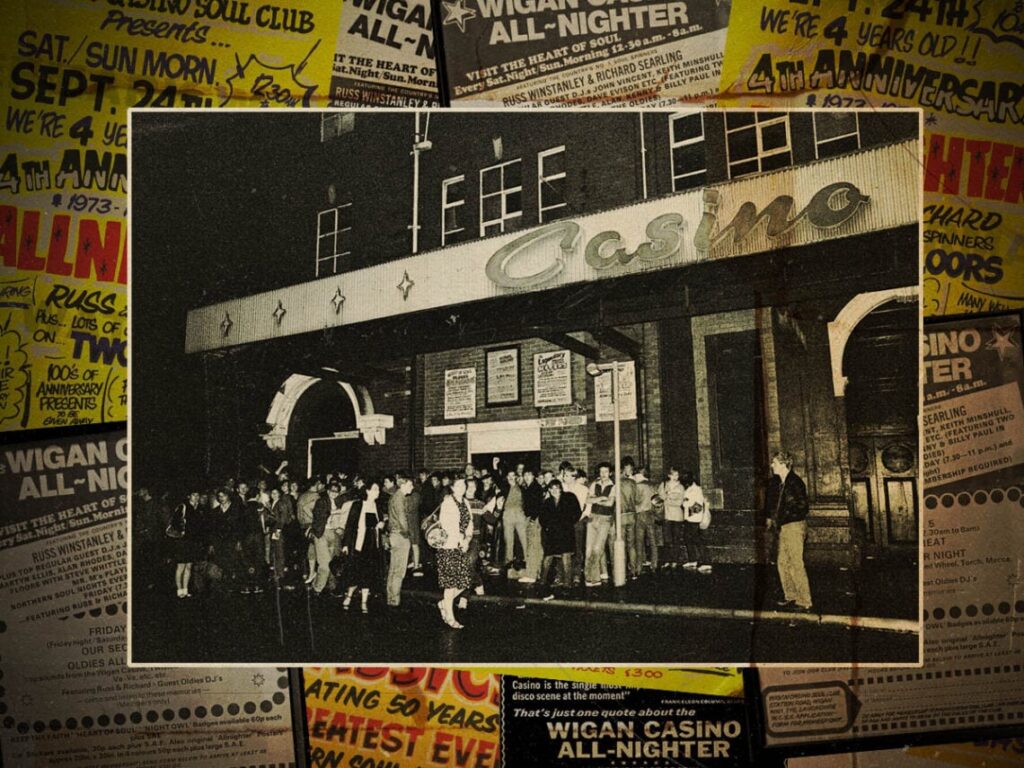
It was in September 1973 that Wigan Casino played host to its first soul all-nighter, with DJ Russ Winstanley selecting the soundtrack for that monumentous night. Before too long, the Casino all-nighters amassed an unparalleled reputation, and the perpetually grey streets of Wigan were suddenly full of soul-obsessed adolescents queueing up to visit this northern soul Mecca.
Inevitably, the same issues which plagued The Twisted Wheel, along with Stoke’s The Torch, and The Catacombs in Wolverhampton, and virtually every other prominent northern soul club, were present during the tenure of Wigan Casino. Drugs still played a huge role in the venue’s all-nighters, and local authorities were keen to crack down on the amphetamine-fueled youth infiltrating their town every weekend. For the most part, though, the venue seemed to evade the same level of criticism as The Twisted Wheel, and there was never a documented, concerted effort to shut the club down as a result of its drug problem.
For eight years and over 500 all-nighters, the Casino Club in Wigan provided a home for the ever-evolving northern soul scene, introducing the world to countless now-iconic tracks, from Gloria Jones’ ‘Tainted Love’ to Frank Wilson’s ‘Do I Love You (Indeed I Do)’. At one point, it was even claimed by Billboard that Wigan Casino was the best disco in the world, trumping even Studio 54 in New York. Not bad for an old Empress Ballroom in Lancashire.
The prevailing problem with Wigan Casino, and the ultimate catalyst for its closure, was that the venue wasn’t owned by the people who ran the events. Like many ballrooms, art centres, and venues during that time, the Casino Club was owned by the local council and was leased out to Gerry Marshall, who helped to start the all-nighters. By the early 1980s, however, the council in Wigan were looking for ways to rejuvenate the town and, tragically, the Casino Club was put on the chopping block.
Reportedly, the council planned to extend the Civic Centre nearby, so opted not to renew the Casino Club’s lease when it came up in 1981. Although the extended Civic Centre never ended up being built, apparently due to a lack of funding, the Casino was still axed. Wigan Casino closed its doors for the last time in December 1981, after having hosted multiple “last all-nighters”, due to the incredible demand. The club’s farewell song, reportedly chosen at random by Russ Winstanley, was Frank Wilson’s ‘Do I Love You (Indeed I Do)’, which cemented its reputation as an indisputable northern soul classic.
Today, the site of the now-demolished Casino Club houses the Grand Arcade shopping centre, and the club is commemorated by a blue plaque next to a branch of Pandora (How the mighty have fallen). However, the spirit of Wigan Casino lives on through the countless reunions and all-night northern soul events which are still organised to this day, often with the blessing and participation of the DJs who established the Casino Club all those years ago.
[embedded content]
Related Topics