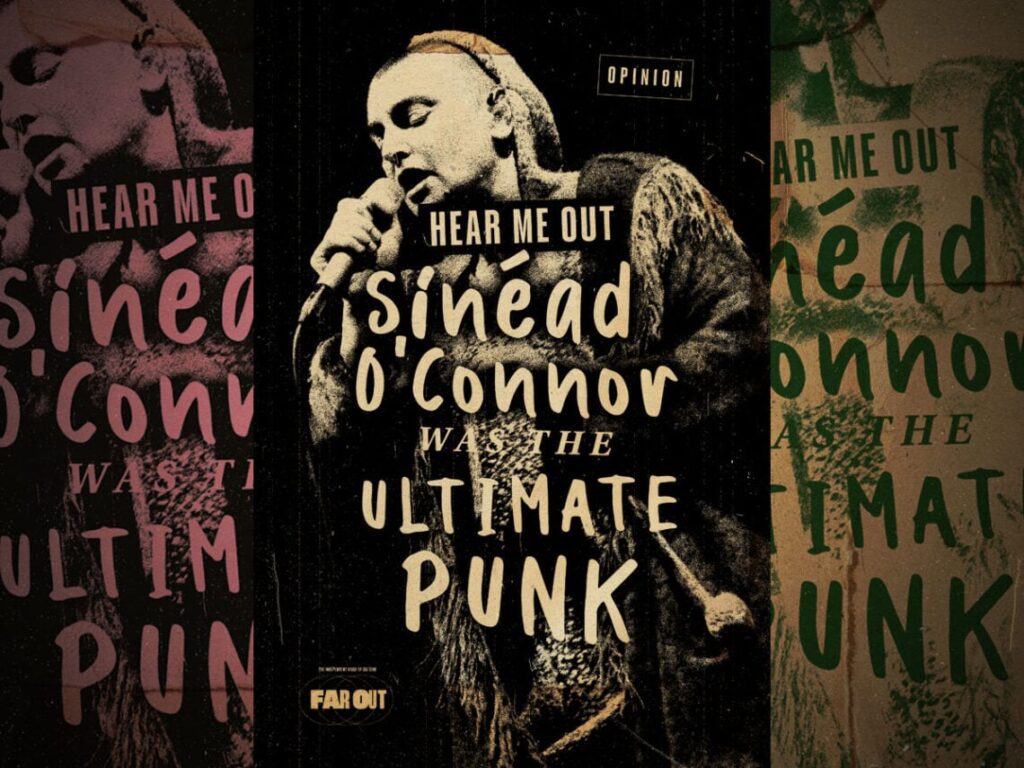
Hear Me Out: Sinéad O’Connor was the ultimate punk
 Posted On
(Credits: Far Out / Man Alive!)
It’s time for a serious call to arms: we really need to readdress our notion of what punk truly is. No, it is not all about mohawks and blazing fashion statements, nor is it a competition of who can scream the loudest. At its heart, punk is more than a genre – it’s a way of life, with protest and rebellion and anti-establishment spirit embedded into your soul, not just brought out as a fad whenever it’s fashionable to be political. Sinéad O’Connor was someone who walked to the beat of that drum through every step of her life.
She did it when nobody was watching, and then still when everyone was, because ultimately she intrinsically knew what it meant to be effortlessly punk without ever having to assert herself as one. Although from a sonic perspective, her music could have been categorised into different forms, it was less of the sonics and more of the inimitable persona that made O’Connor the unsuspecting leader of the modern punk cause.
Of course, the nitpickers will argue that this can’t be the case as O’Connor burst onto the scene a decade too late to be swept up in the punk wave. While chronologically this is correct, therein also lies my precise point – that real punk ideology has never known bounds by time or space or music, and neither did she.
Let’s not forget that in the decades preceding the punk era at its musical peak, the notion of protest never died and, in fact, perhaps became more necessary than it ever was. But where was music when rebellion really needed it in these moments? It was too focused on surfing the glittery synth shine of the new wave, then latterly embroiling itself in the boys and the booze with Britpop, that it often failed to take heed of the world around it. All except O’Connor, that was.
In her own unassuming way, the singer had a casting eye over the world in which she was able to examine unspeakable problems and fearlessly turn them into eloquent lyrical prose. This was undeniably her greatest strength in a sonic capacity, but she knew that it had to go further in order to create real shockwaves, and she never once shied away from putting her neck on the line.
Everyone knows her Saturday Night Live appearance in 1992, in which she ripped up a picture of the Pope in protest of child sex abuse in the Catholic church. It goes without saying that the ramifications of such an act were obviously seismic, but people talk about the incident in retrospect as if O’Connor was never aware of the backlash she would face. The fact was that she absolutely knew, and did it anyway because she knew the message was vital. If you need punk in a nutshell, that’s it.
Then you get to the moment not three years later, when she took to the stage on Jools Holland and declared: “OK, I want to talk about Ireland, specifically I want to talk about the ‘famine’ – about the fact that there never really was one. There was no ‘famine’”. For those who knew shamefully little about Irish history, she was bringing the unsaid truth to the world’s door, staring down the barrel of the camera to truly put the reality of her country to rights. Woe betide anyone who didn’t sit up and take notice.
The other occurrences of O’Connor taking a public stand on various world issues could make for endless reading, but the point that emerges through all of it is the same. She was one woman, bearing up to the big guns of the world not because it would gain her any public thanks, but because, to use her own words, it was more important to her to be a protest singer than a popstar.
When O’Connor tragically passed away in 2023, in many ways, it felt like the guns of rebellion had forever fallen silent. There was, of course, much to be said about her life, legacy, and impact as a result, but among the most striking was a simple anecdote from an Irish artist who was painting a mural of her in a Dublin street. A passerby stopped to question the image being painted on the wall; O’Connor, with her eyebrows arched, eyes square on a target. “Why would you want to remember her looking angry?” they asked the artist.
The response: “Because she had a lot to be angry about.”
[embedded content]
Related Topics